.svg)


The State of TMS: From Transportation Execution to Intelligent Orchestration



Booking a load is the easy part now. The harder question for transportation teams in 2026 is what happens after it books, when a carrier goes quiet or a container sits at port.
In this Logistics Management roundtable, Shipwell President and Co-Founder Jason Traff and Aptean Senior Product Manager Kris Pazhayanoor dig into where TMS technology is paying off today and where the hype still runs ahead of reality. Moderator Michael Levans of Logistics Management/Peerless Media keeps the conversation practical, with routing guide logic, implementation timelines, and AI use cases already running in production.
What You'll Learn
- What resilience and agility look like in daily operations, from routing guide depth to how close your network runs to the edge
- Why shipment visibility only pays off when it feeds directly into execution
- Three places AI is producing value in live TMS environments today: generative AI for analytics, track and trace automation, and freight settlement
- When agentic AI is the right call, and when deterministic automation is the safer bet
- What separates TMS implementations that deliver strong ROI from the ones that stall
- How headless TMS and natural language interfaces will change the way teams work with transportation data
Watch the Full Roundtable
Meet the Panel
- Jason Traff, President and Co-Founder, Shipwell
- Kris Pazhayanoor, Senior Product Manager, Aptean
- Michael Levans (Moderator), Group Editorial Director, Supply Chain Group, Logistics Management/Peerless Media
Key Moments
- 00:00 - Introductions
- 05:16 The state of transportation management in 2026
- 08:36 - How TMS expectations have changed
- 11:07 - The biggest operational challenges for shippers
- 14:09 - Why execution gaps persist with a TMS in place
- 17:25 - What resilience and agility mean operationally
- 21:11 - Why transportation data is still fragmented
- 24:49 - From execution to orchestration
- 28:34 - Are we in a real-time data environment yet?
- 30:49 - Where AI delivers value today
- 34:55 - Generative AI in daily TMS workflows
- 38:43 - How close is agentic AI?
- 42:27 - TMS implementation, then and now
- 47:15 - What separates strong TMS ROI
- 50:48 - The next three to five years
- 54:35 - One piece of advice for transportation leaders
See Agentic AI Inside a Live TMS
Shipwell runs AI Workers alongside your team to handle exception follow-up, missing documents, and status updates once freight is moving. Request a demo to see it on your own lanes.
Full Transcript
This transcript has been lightly edited for readability.
[00:00] Michael Levans
Hello, and welcome to today's roundtable webinar. We're calling it "The State of TMS: From Transportation Execution to Intelligent Orchestration." This is a special event being sponsored by Aptean and Shipwell. My name is Michael Levans.
I'm group editorial director for the supply chain group here at Peerless Media, and I'll be your moderator for today. Now, transportation operations have always been complex, but over the past several years, the environment has become significantly more dynamic. I don't think I have to remind anybody of that fact, right? So shippers continue to navigate ongoing market volatility, shifting carrier networks, rising service expectations, lots of labor pressures, and growing demands for real-time visibility and faster decision-making.
Now, at the same time, transportation management systems, or TMS platforms, are evolving rapidly in response, right? What was once viewed primarily as a load planning and execution tool is increasingly becoming something much broader. Right? It's becoming more of a real-time orchestration and decision support platform capable of connecting inbound and outbound flows, integrating carrier and operations data, and supporting multimodal optimization and helping organizations, of course, respond more intelligently to disruption.
And I know everybody who's in attendance today is dealing with that right now. And of course, no transportation technology discussion in 2026 is complete without addressing AI. Now, over the past 18 months, the industry has seen an explosion of interest surrounding AI-assisted planning, predictive analytics, automated tendering, gen AI interfaces, and even early discussions around agentic AI and autonomous decision-making inside many of our supply chain systems. We're getting there.
Right? But alongside all that excitement, transportation leaders are also asking some important, very practical questions. Where is AI truly delivering value today? Where is the hype ahead of the reality, and how do organizations turn all of this data into faster and more confident operational decisions?
We all want to answer those questions in time. Now, we're kind of headed that way. We are headed that way actually today in the next 45 minutes. Now we're going to discuss the current state of transportation management, the biggest operational challenges facing shippers today, the ongoing struggle for visibility and orchestration, and of course, we're going to touch on that growing role of AI and automation.
And finally, of course, we're going to look at where transportation management technology may be headed over the next three to five years. Now, we have an outstanding duo today joining us. Now I'd like to give our panelists just a few minutes to introduce themselves and tell us a little bit more about their organizations. So, Kris Pazhayanoor, he's senior product manager at Aptean.
Kris, tell us a little bit more about yourself and a little bit more about what's going on at Aptean.
[02:56] Kris Pazhayanoor
Sure. Hello everyone, Kris Pazhayanoor from Aptean. I've been with the Aptean transportation solution now, what started off as Aptean TMS 20 years ago. So been through this journey, what started off as a multimodal TMS.
When we started, we started with parcel LTL, LTL truckload, and we specialized in the tweeners. Right? So it started off as a shipment planning and execution tool. But our background has always been supply chain consulting, so logistics consulting, logistics management.
So with that background, the tool was a natural extension. So we were consulting and management, and the tool aided with the management. So now with Aptean, with Logility part of our family, we're now offering a broader spectrum of transportation solutions that's part of your end-to-end supply chain management. So orchestration is absolutely the way of the future.
You're probably going to hear me talk about it quite a bit today, but that's where we're headed. That's our direction, and I'm here as a part of that leap forward.
[03:59] Michael Levans
Awesome, Kris. We're really thrilled to have you. And Jason Traff is president and co-founder of Shipwell. Jason, welcome.
Tell us a little bit more about yourself and a little bit more about Shipwell.
[04:09] Jason Traff
Thanks, Mike. I'm so excited to be here with you and Kris. So Shipwell is an AI supply chain execution platform. We are best known for our end-to-end TMS, so planning, rating, shipping, and managing in a multimodal REST API microservice TMS.
We are entering our 10th year just in market now, so it's been an exciting time for us just seeing how the industry has changed. Today, we will do billions of dollars of freight spend, hundreds of millions of data points across millions of shipments. We've spent the last six years in Gartner's Magic Quadrant for TMS. In that time, we've gone from a niche player to a challenger.
In the last few years, we've actually been in the visionary quadrant in recognition of our work in generative and agentic AI, which luckily you said it before I did. I didn't have to be the first one here saying AI. It's a stat that we're really excited about, that we'll talk about later, I'm sure, is that we are doing one agentic action every two seconds in a live TMS environment in real supply chains today. And so we're really excited about that direction, and I'm excited to be here with you guys today.
[05:16] Michael Levans
That's awesome, Jason. We're looking forward to hearing more about that, too. Kris and Jason, we're thrilled to have you guys here. So in a traditional B2B panel discussion, we always start out with that 30,000-foot view.
Now, how would each of you describe the current state of transportation management now as we're sitting here in 2026 right now? Kris, I'll kick it off with you. How would you describe the current state of transportation management right now?
[05:43] Kris Pazhayanoor
Right. So I think we've all seen the note about volatility, right? I think there's plenty of memes that talk about how every day in a logistics person's life is a new challenge. They're riding a bike, everything's on fire.
The bike is on fire, you're on fire, truck fire. I mean, if you thought that was a norm, now amp that up 10x, and that has now become the new norm. So what used to be an internal or intrinsic volatility has also now been, as we've seen, there's market volatility, there's external political, geopolitical volatility, and that really has forced logistics to look at their supply chain end to end. Right?
So we're seeing that as volatility aside, volatility is the norm. Amplified volatility is the norm, right? That has become the thing these days that you have to plan for and you have to accommodate for as the big deal. So what used to be, can my system execute a load efficiently?
That's kind of assumed now. It's kind of like, can my system coordinate a response across the whole network and even look out for me for things that I am missing, is the direction I think we're heading. So in that sense, 2026, I think, is the year transportation stops being a bit of a standalone silo and starts becoming this across-the-chain layer thing. So that's where I think we're headed, both from our system and the state standpoint.
[07:11] Michael Levans
Yeah, definitely more towards the orchestration. Jason, how could you add on to Kris's perspective there in terms of where we're standing in transportation right now?
[07:18] Jason Traff
Yeah. I agree with everything Kris said. I think one of the fun word games we'll play is how many times we use the word volatility. It's almost like, oh, something's going on, I'm not sure.
I mean, I think the story is similar. I think it's the times that have changed. So teams are still capacity constrained, markets are as volatile as they've ever been. But when we look back over the last few years, especially with COVID, it used to be that transportation and supply chains just broadly were back-office functions.
They were just call centers, yell at people more, keep costs low, keep goods on shelves, and that still exists. But increasingly, I think what COVID did is show people that there's a real competitive advantage to being really good. And the emergence of the e-commerce giants like Amazon have shown people really what a vertically integrated supply chain can do as a competitive advantage. And so the application's different for different companies and their specific footprint.
But outside of having more conversations about fuel surcharges probably in the last six months, I think the dynamic is still the same. But I think for the best companies, they have executive backing. They understand there's millions of dollars of savings, there's the same competitive advantages, and so we're still seeing initiatives where people say, "Hey, transportation's really important. This is something to focus on right now."
[08:36] Michael Levans
Absolutely. And it's right. It's raised that awareness, and it's pushed more and more shippers, more and more logistics operations towards applying TMS because there were still many who weren't up and running on that. That's something we love to see from our perspective, from covering the market.
Now guys, over the last 12 to 18 months, so what has changed most dramatically in the expectations companies now place on their TMS platforms? How is that changing right now, Jason? What are you seeing?
[09:05] Jason Traff
Well, I can tell you that people definitely aren't more patient than they have been. So I think speed to value and speed to answers are critically important. I think it's a really difficult proposition to say, "Hey, let's start down this path. We think we can be better at it.
It's a three to five to 10 year initiative for us." I don't think a lot of people are thinking of those timelines right now. I think realistically, a lot of these initiatives are same year if not shorter. And so I think we're seeing that pressure from companies that really want to get good at this and get good at it quickly.
[09:41] Michael Levans
Yeah. Kris, what do you think? Are shippers asking fundamentally different questions than they were just even two or three years ago? What are you seeing from your unique perspective?
[09:50] Kris Pazhayanoor
Yeah, I think speed is a fantastic point, right? I think AI is only accelerating speed. At the enterprise and higher levels, I think to some extent what used to be a big deal is now table stakes, right? So the first thing is they expect a TMS connect with everything.
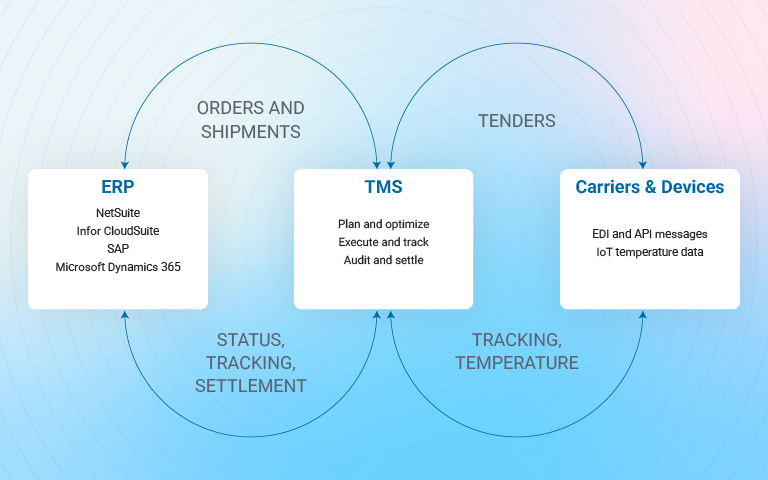
Supply planning, planning, warehouse operations, ERP, everything, right? So that's a given. The second thing is, they want AI agents to do the work for them, back to the orchestration component. So the chatbots and LLMs are done.
So when you say agent, the vision now is not of a chatbot but of something that actually does things. And then the third piece is back to what I was saying, the expectations, the consultative and knowledge expectation. Configurability is a given. You almost have to be configurable for your system to be ready for AI.
But does it understand my compliance requirements, right? So does it understand my customers? Does it understand my industry, food and beverage, for instance, right? I mean, the temperature requirements, the customer delivery requirements, the routing guides.
So these are all, right now, where we are having these conversations. Not so much the things that shipment execution is at this point. We've moved past that.
[11:07] Michael Levans
Yep. Well, guys, great job of setting the current environment. Nailed it, right on. I think that's what a lot of our attendees today are feeling.
Now let's talk about some of those challenges that you're seeing and what our shipper readers and attendees are seeing. Now, obviously, despite there's some softer freight conditions in a couple modes, but the transportation teams still are feeling under enormous pressure right now. So what are the biggest operational challenges that your customers are trying to solve right now, due to this current environment we just defined? Kris, why don't you kick us off there.
What are some of those challenges you're seeing your folks going through, your customers?
[11:44] Kris Pazhayanoor
Sure. So business as usual is no longer the case, right? I think that's going to be my key point because, for instance, let's take a couple of specific examples that Jason probably knows this very well. That in the industry, the role of density and cubic volume has now crept up from parcel to LTL.
That's already old news, right? So the external constraints are pretty significant at this point. I mean, the general constraints still exist, labor capacity constraints, visibility gaps, carrier performance, mode optimization. So those standard rules are still apply.
But the transformation of external, like again, I mentioned geopolitical challenges. How are you adapting to that and are you reacting to that, is the key question now, right? Is it now becoming transportation's problem to accommodate for something that is happening way upstream? And how do you actually roll that up upstream to solve it there instead of having to reactivate and expedite freight?
How can we prevent that? And so those are the kinds of questions I believe we're seeing now and the challenges that are occurring.
[12:50] Michael Levans
Yep. What are some of the challenges, Kris, or I'm sorry, Jason, you can build off of Kris's feedback there, which is right on. What are you seeing in terms of some of those challenges from your unique customer base?
[13:02] Jason Traff
Yeah, absolutely. So our customers are mainly mid-market and enterprise shippers, usually in heavy freight industries, food and beverage, retail, manufacturing, that sort of thing. And I think the two big buckets are always cost and visibility. I think though that the difference comes in the different tiers of how people approach those challenges.
So when you first start out, gathering master data, putting everything together, even understanding how many shipments you do or how much you spend on freight are big challenges. Later, as you get into further years or further levels of integration with the TMS, then you start really peeling that onion back, right? You get more proactive, you get more automated, you get better reporting, better real time answers. And so I think for a lot of customers, the themes are still the same, it's just that where they are, the journey is different.
And I think what's been really cool is we're now seeing customers that are multiple years in. And so how far they've come, as they've gathered a very strong foundation and built more automation, more progressive integrations. They're really starting to leverage some of the things like AI and agentic automation that has been really cool to see.
[14:09] Michael Levans
Right. No, that's a great point. Great. Well, guys, let's shift a little bit in terms of the challenges now.
I mentioned that a little earlier, that through a lot of our research, we're still finding that there's still a significant amount of logistics operations still not up and running on a TMS. However, so many are, right? So many organizations already have that TMS in place, right? But yet they're still struggling with execution, consistency, and agility, right?
Why do you guys think that gap still exists? Is it really just a technology issue? Is it a process issue? Or Jason, you alluded to the data issue, or is it all three?
And Jason, can you lead us off on that one? What do you see in there? What's the gap?
[14:48] Jason Traff
Yeah, absolutely. So our time in market, and I think industry stats back this up, about 80% of mid-market companies, so these are $100 million in revenue to sometimes a few billion. 80% of those companies don't have a TMS. But the people that work in their supply chains probably have used one before. And so they understand how it should work.
But there's such a big gap between gathering all the data, doing the change management. A lot of our companies are either fast-growing or they might be private equity backed. And so what starts as one company with 10 locations, might have plans to be four different companies over 40 locations all in one place. And so I think when you think about how much detail has to go into selecting a TMS, making sure the change management, the workflow, all those pieces come together, it creates a lot of room for gaps, right?
There are a lot of frictions that goes into that. And so I think this is where those gaps happen. There's so much change that has to come as you bring everything into one center, source of truth kind of thing.
[15:49] Michael Levans
Absolutely. Kris, what are you seeing from your unique perspective in terms of why those gaps still exist for folks who are up and running on a TMS already?
[15:59] Kris Pazhayanoor
100% agree with Jason. So these are companies that have grown, and they've scaled up, and then they've not yet experienced the pain of that growth or the flip side of structural thinking that you need to have in order to get to that growth level, right? So I'm going to pretty much reword exactly what Jason said. So process and data.
You need good solid process, and you need clean data for you to apply technology and scale technology. That's the bottom line. Even with AI, those fundamentals exist. I would say, especially with AI, those fundamentals absolutely matter even more.
Because without clean data, you're going to have an agent that is going off of bad information with bad signals. It's good at processing ambiguous data, but it is terrible at reflecting and acting on bad data. So that's where it's really important that we make that distinction. Likewise, orchestrating or workflow agent, right?
So the agents that actually do things where you configure them to follow a certain process. If your business process itself is wrong or the assumptions that you've made, the guardrails that you've put in place for these agents are wrong or based on invalid assumptions that are not in sync with the industry, you're going to train an agent to do the wrong things. So process and data, fundamentals still matter.
[17:25] Michael Levans
Absolutely. Man, more magnified now than ever, the whole data piece of that. We've been writing about that and talking about that for 20 years. Now the magnification is through the roof.
Hey, guys, I have a question here. This is more almost like a question I threw in here because for me personally, I want to hear what your feedback was. But we talk about, we've seen and written and heard about the terms resilience and agility over the last few years based on what we've all been feeling in terms of the volatility right now. But operationally speaking, what do those concepts actually mean inside of a transportation organization today?
Almost like a little bit of a personal question, guys. But Kris, can you kick us off with that one? What does it mean? What do you believe that means?
[18:11] Kris Pazhayanoor
Right. Pretty straightforward. Again, I'm going to remove the buzzword side of this and illustrate what would actually happen. So resilience in my mind is based on what our clients do is if something breaks, do you have a plan B?
Agility is how quickly can you act on that plan B? A very simple, straightforward example. So you have how many carriers are in your mix at this point that you tender to? Do you have auto tender?
So those are the two pieces. So the first one's resilience. Do you have an A, B, C carrier, and then you have a follow-up plan or a backup plan? And when A is unable to pick up or unable to confirm load, are you able to go right to B and then to C, and then you execute your, "Hey, there's a problem here," workflow if A, B, and C all fail?
That's as simplistic as it gets in my mind.
[19:05] Michael Levans
Yep. Jason, how would you add to that? That's a great answer, Kris. That's dynamite.
Answer that personal question for me because we hear those words, those buzz terms all the time.
[19:18] Jason Traff
Absolutely. So for me, resilience is how close are you to the edge at all times. Because if one thing goes wrong, how close are you to having a really bad day? Because I guess the spoiler alert would be we operate in transportation.
Something's always going wrong. These are things that happen in real life, in the real world. Something's guaranteed to go wrong. So how would you design resilience as part of the solution, right?
And Kris gave a great example with routing guides. That's the thing. There's always going to be a carrier that can't pick up. How deep does that routing guide go?
And then for agility, I think Kris had it right in terms of how fast people can do the speed to making a decision. My view is that supply chains have always had really asymmetric risk. And so when I think about this, I think about if you can improve something, you can automate something and solve 100 shipments, but one shipment's going to go catastrophically wrong, it's usually not worth it. And so when I think about the agility part of it, both my co-founder and I, we have backgrounds from MIT, but my co-founder, Greg, was doing Fortune 100 supply chain consulting.
And when you look at some of those organizations, it could take months. They're very complex, but any question, a spend cube could take months to put together. And so for us, most companies today, we think about agility in terms of vertical integration. So I guess the example everyone's aware of, especially for those of us that are in industry, there are probably a lot more examples, but when COVID happened, all the toilet paper disappeared, the mac and cheese disappeared, the vinegar.
And for some of those companies, the vertical integration from point-of-sale data to procurement to making sure things were back on shelves was very cumbersome. And so when we think about agility, I think for us it's a mixture of having speed to data and making sure that you're vertically integrated, that you can make smart decisions to complete that full loop.
[21:11] Michael Levans
Outstanding. Thank you, guys, for that. It was kind of a personal question I threw in there, but I'm so glad. Now, we're just going to keep rolling on some buzz terms right now.
Two of the other buzz terms that keep buzzing or popping up is visibility and orchestration. Right? So obviously, visibility has been a major industry buzzword for years. I've been covering the market for 20 years, and we've been looking for that.
That is the holy grail. Yet many shippers are still struggling to get a truly unified view of transportation activity. Why do you guys think is transportation data, why is it so fragmented? Why can't we get to that visibility?
Jason, you kick this one off, if you don't mind. What do you see in there?
[21:51] Jason Traff
Yeah, absolutely. And you've been in the industry for 20 years, so you know how much it's changed. Even from us, when we started Shipwell 10 years ago, the ELD mandate hadn't even gone into effect. So most carriers were still using flip phones.
They were writing down hours of service in a physical book. And today, Shipwell will process three million visibility updates just today across 100,000 connected carriers. We build machine learning algorithms around ETA and traffic. And I think the way that we've always felt is that visibility has to serve as a foundation for execution.
Because the first thing is do you know what's happening? Do you know what's happening in the real world? How are you finding out about it? But once you have it, you really need that visibility to tie closely into execution, otherwise it's just impotent data.
It just informs you, but it almost creates more work because you're just aware of more problems. If only if you can start to build it tightly into execution, that you can get that level of proactive. Right? How can you shift the supply chain from just a reactive sense or proactive?
And I think that's always dependent on visibility leading into execution.
[22:55] Michael Levans
Yeah. Makes a lot of sense. So Kris, how would you tackle that one in terms of why transportation data is still so fragmented?
[23:04] Kris Pazhayanoor
I'm actually going to go back to your question, right? So visibility has been an industry priority. Which industry? I think that's where it starts to break down because the LTL industry is different from the parcel industry, is different from the truckload versus the ocean.
And the modes are different. I think for each of these, the modes are different. One is way more reactive than the other. For some, technology is absolutely imperative for them to operate.
For others, it's just, hey, if it gets there when it gets there. Right? The good thing is there is a bit of a trickle up effect, I guess I want to call it, this one, not a trickle down, because of how parcel leads, and then LTL, and then truck, and so on. Right.
So I think we're getting there. I think even APIs which were a big deal, I remember this. I've been in the industry long enough to know that that was not a given, but now it is. So we're getting there.
I think we're absolutely getting there. Fragmentation, unfortunately, is a consequence of how the industry itself is fragmented, right? I think given that there is a lot more consolidation and everybody's now working in unison, the eBOL initiative is a great example of the whole industry coming together to do something that is for the betterment of everyone. So that is happening.
We are heading in that direction. Here again, my hope is that collectively, all of us would come together and use and leverage AI to get there faster. So back to Jason's point about speed, TMS systems are being demanded that we get things done quicker. I think we need the same demands from the industry.
[24:49] Michael Levans
Yep. Great point, Kris, about the multimodal, the different modes going at different paces. So that kind of leads in really nicely to this next question on how are modern TMS platforms evolving from execution systems into broader orchestration and decision support platforms? The inbound, the outbound, giving us that multimodal visibility, scenario planning, getting to that another holy grail moment at a control tower functionality.
Now, how do you guys see the TMS platform really evolving there to give us that orchestration? Kris, how are you seeing that unfold right now?
[25:27] Kris Pazhayanoor
Yeah, absolutely. So this is, again, my introduction was the same thing, right? So this is exactly where we're heading. And I hear the word control tower, and I do want to say that it's quite a bit deeper than that, right?
I think, so let's think of it as an arc. So we started with execution, and then we said, "Okay, I need more. I need visibility." And then we built that control tower.
But now we are going into orchestration. So what does that really mean? It means that there are not just single decisions, but entire workflows that are built on multiple inputs that you receive from multiple sources. So that industry fragmentation is now addressed.
And so think of it as what would you do, person, when you see this, when you hear this input? Would you email the carrier? Will you call the carrier? Will you let purchasing know that there's an inbound shipment that's delayed, so they have to adjust the manufacturing lines?
So those are all the decision workflows that happen. What used to be a very complicated workflow, "Hey, vendor, what are you shipping? How much of that are you shipping? Do you have the right HTS code on them?
Do you have the paperwork? Is the paperwork a real packing list, or did you just upload a PDF that was a receipt?" Right? So those are all the kinds of things that now machines and machine learning can make using agents.
So the entire orchestration of an end-to-end workflow, which used to be today, people doing those same mundane jobs, emails exchanged, that is kind of where we're headed, where all of that, where execution does not just do a task, it executes an entire workflow, is our decision support platform. And then make real impact of actual things that matter, right? Adjust inventory, adjust your manufacturing schedule. So it has to work upstream, end to end.
It can't just be about shipments and tracking anymore.
[27:15] Michael Levans
Right. Absolutely. Great points, Kris. Jason, how would you dovetail into that in terms of how you're seeing TMS platforms evolve?
[27:24] Jason Traff
Yeah. I think you guys touched on it. Right? The industry landscape has always been a little bit confusing.
There's so many different tools and acronyms and what overlaps. I think our guiding principles have always been what customers need and what do they want. And I think so much of it centers around connectability. Kris hit it, it should be end-to-end and ideally as few solutions as possible.
If we think about how supply chains have changed, whether the past few years or decades, as supply chains are more connected, you can do more and more. In a world where everything used to exist in a silo, where there was no real-time data, you have these very narrow, brittle solutions that just sit next to each other. Right? An army of people typing information in, an army of people reading it.
You have a very small slice in the middle where everything exists in real time. And so I think for us, when we think about it, I probably can't speak to the other platforms, but this broader move from just being a pure execution, creating a shipment, pricing a shipment, tracking a shipment. That's a very narrow scope of what customers need to efficiently operate and optimize their supply chains. And so I think those are just the natural parts of how customers find value in a more connected solution, which ideally is great for everybody.
[28:34] Michael Levans
Right. So from what you guys are telling me and what we're talking about here today, guys, the APIs, IoT connectivity, real-time data, all those data feeds continue to mature, right? So we're getting there. This evolution is, we're almost there, right?
So we're finally reaching a point where TMS can operate from a more synchronized, real-time data environment. Would you say, Jason, or do you feel we're there?
[28:58] Jason Traff
Yeah. I think it's a process, right? I guess the caveat is it is a process. But we've been here for years now.
And I think the ELD mandate was really one of the first big switches where truckload got some form of structured data. And for us, we love structured data. I'm so much happier whenever I can bring an update back through API or EDI. But the thing is, even with agentic AI or just generative AI, some of the notes, the manual notes, the transcribed phone calls, those parts that still exist in supply chains today, you're starting to be able to build more structured data off of those as well.
And so I think we're here. I think a lot of the reticence that the carriers have had about providing these things, the pace of change, I think we've really turned that corner now. And I think the cool parts could be what happens in the next few years, what we're able to build on top of that more synchronized real-time data environment.
[29:51] Michael Levans
We continue to cover that in Logistics Management and across all of our publications. The tools exist. Kris, would you agree, right? Those tools are here already.
They're ready to roll. Or are there more integration challenges that are still holding organizations back, Kris? Or what do you think? The tools are here, what's holding us back from that?
[30:12] Kris Pazhayanoor
No, I would, for the most part, agree with what Jason's saying. I think as a group, on average, we're definitely heading in that direction. The one little caveat that I'd add is the supply chain is only as strong as its weakest link. If there's a provider mix where one or two is not giving that data, we make API calls and then one carrier times out, it just holds back the entire stack, right?
That is the only challenge. But again, 100%, we're getting there fast. We will be there, same time next year, my hope and expectation is that it'll be a very different answer.
[30:49] Michael Levans
Yep, that's awesome. That's right, and that's great to hear. I guess I'm going to shift gears here a little bit more, then really focus in a little bit here in the next few minutes on the AI side. Obviously, it's dominating a lot of supply chain conversations this year.
A lot of the conferences we've already attended this year, number one conversation point. Now, from your unique perspective, where is AI delivering legitimate value inside transportation management today? And where is the hype still ahead of the reality? Right?
So Kris, why don't you kick this one off? Where do you see that legitimate value happening right now?
[31:23] Kris Pazhayanoor
Plenty of spots. It's almost like, where does a TMS have an impact? It has impact on customer service. It has impact on purchasing, on logistics.
It's not just a shipping execution tool, right? Likewise from our vantage point, we've been using [unclear] for several years now, automated document parsing and automated imaging. So that is from years ago, even before LLMs, well before LLMs. But things like automated exception communication with carriers, when there's automated exception.
So that's a great example of that. Automated alerts, automated workflows, agentic workflows, approval processes, vendor onboarding, carrier onboarding. That is where there are a significant amount of realistic expectations. And then I think I have to quote my CEO.
One of the things that way back when this whole thing got started. I think it's probably even going a couple of years. His point was, don't think about it as what an agent can do to a system. Think about all the tasks being performed by an agent and how can a human do it when an agent can't.
So he kind of flipped the script on it and said, as a product manager, think, build your product so that you can do all these things and then just let the human decide it when there's exceptions. So once that flipped, I think the way we built the products changed significantly.
[32:49] Michael Levans
Yep, that makes a lot of sense. Jason, how would you add to that in terms of the legitimate value that AI is bringing right now to TMS platforms?
[32:58] Jason Traff
Yeah. And I could spend the entire session talking about this. Because it's changed so much, even the past three, six, nine months, the sentiments and the capability. And so I think to give tactical, very solid, direct answers, I think there are probably three areas that we see production customers finding value today.
So the first one is probably just generative AI for analytics. It eliminates the need for a custom report. You can just ask a question, get a real-time answer. And what that means for so many customers is, hey, your boss shows up and wants to know a number.
How many dollars did we spend on this SKU on this lane in the past three months? Before, that might've been a multi-day, find a data team, build a custom report. Today, you can get that answer in a minute. And that means you can actually make a decision off of it while you're both in the room together, and that's a big shift.
The second, track and trace. So, we have agentic track and trace digital coworkers that automate sometimes like 70% to 80% of the manual effort that goes into resolving exceptions on a shipment. So messaging carriers, collecting missing documents, updating shipment statuses, all automated through a configurable agentic AI. And then probably the last one is settlement.
So, automating invoice collection, recognizing what physical scanned documents say, making payments. And I think for us, we've now processed billions of freight documents. So we're familiar with the ones that look great and are well formatted, and the ones that are very poorly scanned. And AI detection is pretty good now.
And so there are, to Kris's point, there are dozens of other things that we're working on that we're excited about. And yesterday we held our AI co-innovation panel with our customers, and they had another dozen ideas. And so the technology is very much there. It's really about how quickly can someone build it and how quickly can an organization change to adopt it.
[34:55] Michael Levans
Yep. Got you, Jason. That's terrific. And I had a couple questions rolling in here, one more on gen AI and the other one on agentic.
So in terms of gen AI, it has moved deeper into TMS workflow, Jason, you just mentioned that. So again, so how practical are those capabilities, the gen AI capabilities in becoming in real world transportation operations? What you just mentioned there, it's extremely practical. You guys are, it's moving through your process right now.
[35:21] Jason Traff
Yeah, absolutely. We've had gen AI as a chatbot widget in the TMS for about three years. And it started as just an assistant for people doing integrations into Shipwell. So it sat on our developer API notes, helping people with integrations, and it moved into the TMS where you could ask it very standard questions, very basic Q&A.
I think really though, what's been interesting in how we think about how gen AI changes is, Shipwell last 10 years, we've seen basically three shifts in how customers interact with data. The first one was this idea of the giant table, the hamburger menu, the aggressive filtering, different roles for planners or dispatchers. And then the second one, moving away from that just giant table of information, was really when real-time visibility started coming into the picture. So it wasn't about the thousand shipments you're doing, it's about the five that are going to go wrong today.
So how proactively can you filter that to direct attention? And now the third one, and we see this a lot with, especially our companies that have younger workforces, they will interact through the TMS because the gen AI can now do so much more than just basic Q&A. What it's doing now is it's helping them build shipments, schedule appointments, and just asking questions in natural language. So I think that's where we're finding its natural footing.
It's a different relationship of just rather than reading the screen, you're really having a conversation with it.
[36:48] Michael Levans
Got it. Yep. Kris, how would you dovetail into that into Jason's comments there in terms of gen AI, the practical capabilities? It's here.
It's in a real-world transportation operation. What are you seeing, Kris?
[37:01] Kris Pazhayanoor
Yeah. It's amazing how similar the thought process is, right? So when this whole thing got accelerated a couple of years ago, one of the challenges that I've been thinking about, one of the fundamental rethinks that I've had to make is, what is the use of a user interface, right? What is human computer interaction going to look like in the agentic world?
Why are we filling forms and buttons, right? The forms are from the 1800s where you used to fill out a paper form and submit it to someone, right? So that's why we had a submit button, because you were handing over a piece of paper to someone else. How relevant is that in the agentic world, right?
So as a product manager that designs the UI, I have to have a fundamental rethink of how things work and how people are going to interact with systems. And that starts with decisions, right? That starts with the kind of actions we're taking. If you're going to be building a system that still asks you to fill out data, you're going to be doing the same thing five years from now.
So I think that's where the movement should be. How close we are, we need to have a fundamental rethink of our structures, of our systems, of our architecture in order to get there, and that's the whole groundwork that we have been doing over the past couple of years, is to lay all the groundwork to get there. Right? So I think we're there now.
So it's close. But I would challenge every product owner out there, product manager out there to say, "Hey, are you still building a SaaS tool in the age of AI?" Right? I think that's a fundamental rethink that we have to think about.
Just hard questions we have to ask ourselves, and I've been asking myself for sure.
[38:43] Michael Levans
Guys, look, here, I'm going to wrap up this section just briefly. And you both alluded to how close we are, right, eliminating or should I say creating that minimal human involvement environment, right? So Kris, let me just stick with you just to kind of wrap up this section. With agentic AI, how close are we to that reality and bringing down that minimal human involvement from your perspective?
[39:11] Kris Pazhayanoor
I think once the data structures, the data transformation strategy, the system architecture is complete, it's very easy to get there. So that part has taken a long time, especially systems that have not been built from the get-go for that, that has taken a long time. But now, once that's done, and this is a global answer, right, across products, across ERP or across TMS, doesn't matter, that transformation is very quick. There are a lot of systems that are out there that are building the front layer, the agentic layer, without a revisit of the back end.
And it looks great now, just like vibe coding. It looks great now. Is it a production system? That is a question I would ask everybody, right?
So I think that's kind of where we are. We're there. As long as the background work is done, we're very close and way ahead.
[40:06] Michael Levans
Yep. Jason, how would you respond to that in terms of, you had mentioned, you had alluded a little bit to agentic. How close are we to that reality? Can you dovetail off of Kris's response there?
[40:18] Jason Traff
Yeah, absolutely. So I think Kris is exactly right. I think the first part is how good is the data, how good are the models for it. Everyone's heard of garbage in, garbage out.
And so I think that's the first point to call out. I think the second one for me is that there's a difference between AI, especially agentic AI, versus just automation. Automation has existed in supply chains for decades. And our view is that sometimes the best AI systems might not use the most AI.
Kris mentioned vibe coding. The idea of vibe coding a TMS is very scary. AI excels when it's a non-deterministic outcome versus a deterministic one. If the color's red, do this action 100% of the time.
AI is not great at that, and you need to have very high levels of confidence in the supply chain because if something goes wrong, it can go really wrong, right? It can really get away from you. And so sometimes the best ways of approaching AI is to use as little as possible. But to your answer your question directly, it's very much real.
In terms of what we've seen for agentic AI becoming a real digital coworker for some of our customers, most roles outside of supply chain as well as within, about 50% to 80%, based on studies, can be automated through AI today. Now, you might not have all the right tools, you might not have all the right processes to do that, but most people, even outside of the industry, will spend 50% to 80% of their time on low-value tasks that could be automated through AI. And we have lots of case studies. Customers that are able to recapture dozens of hours of low productivity work and really put it into the strategic parts that they never got to, right?
So I think our industry is rife with people that you work through the checklist, and the top three, there's a chance you might get to it. But some of those things, the nice to haves that get buried lower down that top 10 list, you just never get to. You never would like to as a resource constrained business unit. And so I think what we see from agentic AI and how we've seen it put into practice is it's very much real.
It's peeling off low-value work and putting in levels of automation that are allowing people to become more strategic and ultimately drive better business outcomes.
[42:27] Michael Levans
Yep, absolutely. Guys, great job on the AI portion. It puts so much into perspective, and I really appreciate that, Jason and Kris. Great job, guys.
Now, I'm going to shift just a little bit here in the time we have remaining and maybe talk a little bit, at least the next five, six minutes, on implementation. Let's bring it down to some fundamentals now. I think we mentioned, I'm not sure if it was Kris or Jason, you mentioned, guys, something like 80% of the mid-sized companies still are not been running on with a TMS, right? And that's what our research is still finding.
And to me, I still scratch my head and say, "All right. What do we need to do as a media source to help push and get that number down?" So guys, I'm going to ask this question. TMS implementations historically carried a reputation for being complex and time-consuming, right?
How has that reality improved over the recent years? So Jason, why don't you kick that one off. How has it improved?
[43:20] Jason Traff
Yeah. I think a TMS implementation is as complex and time-consuming as a business is complex. Teams still need to be properly resourced. Gathering master data is often difficult, especially with multiple business units and locations.
Training teams for best practices, changing workflows, these are all elements that persist. But the ROI, the cost savings, efficiency gains for a TMS are gigantic. It's one of the best investments a company can make, especially if they ship freight. And so for Shipwell, one of the things that we've done, because we started using our AI applications internally first before we ever exposed them to customers, was we began using it for things like implementations.
So we were already in a world that we generally finished implementation in about a third to a quarter of the time as most of our legacy competitors. So this usually means like a six to nine-month implementation as opposed to a two to three-year one. And so one of the things that we started doing was recording all of our calls. AI transcription.
That's then fed to our own internal generative AI that not only captures all the best practices but also has access to our entire code base, our release notes. And what it's able to do is create implementation documentation and cite best practices. And so this has helped us speed up the creation of statements of work, of change orders, creating user guides for the TMS. And a lot of logistics departments struggle with turnover in their teams, and it's not uncommon for a customer to come back three years later and say, "Why did we make that button red?"
And so being able to bring this back and present that back to the customer not only helps them get up and running faster, but it provides a more stable knowledge base for them once they are up and running.
[44:58] Michael Levans
Yep, outstanding. Kris, share with us, too, can you share with us your perspective on how implementation has changed over the recent years and try to take some of the mystery out of it for so many of our folks and our attendees today who might not be up on the platform right now?
[45:16] Kris Pazhayanoor
Absolutely. So back in the day, five years ago, challenge was carrier integration. I think it's a non-issue at this point. We have an automated internal workflow.
We throw an API document at it, it auto codes, and integrates a carrier without any human coder at this point. So, API integration, absolutely a non-issue. So carrier integration is a non-issue. AppCentral, we actually launched AppCentral last year.
Basically, AppCentral is a collection of a suite of applications that our customer would want. Today, they decide that they need a TMS. They go in, they click a button, and then auto-provisioning of the customer, auto-provisioning of the user, the seed user, pre-built templates, industry templates, like industry vertical templates, as well as user-specific templates, like roles and so on and so forth. So, I want to go back to what Jason said.
He is absolutely spot on. Straightforward implementation that used to take a long time before is now instant. Not just a few minutes, instant. Especially for us, given our AppCentral push and so on, the complexity is where things start to take time.
First, it's a matter of understanding it, and then a matter of implementing it, and then a matter of training the user. So there's the three phases that we have to go through. We have been working very hard to address that on our side, especially because a lot of our implementations can be very complex organizations, multi-sites, multi-workflows, [unclear] in nature. So we have been actively working on addressing that as well.
And they started with, back to what I said earlier, the data structures that can support auto-configuration, learning from what the user does, automatic configuration workflows and so on. So that's the direction, again, that we're headed towards. Hopefully we can get to a point where the system listens to a sales call and by the end of it, "Here you go, your system's ready to go."
[47:15] Michael Levans
That would be awesome. Well, you guys both did a great job of sort of breaking down the wall there for a lot of folks who have always been a little bit, not skeptical, but yeah, maybe just a little intimidated by making that move. So Kris, I'm going to just stick with you and stay on that line you were kind of heading down there, in terms of once you're up and running, then you've got to put some effort in. I get that.
So Kris, from your perspective, what separates a company that achieves strong ROI from that TMS implementation, that investment, from those that struggle to realize the value from it? What separates those who really get that strong ROI from their TMS almost right off the bat?
[47:57] Kris Pazhayanoor
Right. So I think it needs to be a mutual benefit from the system. So if you're looking at a TMS as a shipment execution system, "Hey, I'm not calling carriers anymore because the system does it for me," that was from 20 years ago. So those days are gone.
You have to learn from it. You have to level up from it. So you kind of have to elevate yourself because the mundane is being done by the system. So that is where you do maximize and amplify your ROI.
What is it telling you about your business that you didn't know? That's the key question. Back to what Jason was saying earlier, what used to be a query that you would have to run a report and manage multiple sheets to view, should be a gen AI query that you put on AppCentral in our TMS right now. And we actually have a pre-built template that prompts users and says, "Hey, these are the questions you should be asking the system."
So if you go to our gen AI query, it comes up with those questions. So that's the knowledge and skill is what you would gain from any gen AI or AI-powered TMS.
[49:08] Michael Levans
Yeah, absolutely. Great answer. Jason, how would you dovetail into that one, too, in terms of what separates a company that's going to get that strong ROI right away, as opposed to someone who's struggling?
[49:20] Jason Traff
Yeah. And I think Kris touched on it. Yeah. There are a dozen ways to get ROI through a TMS because it's so central to just supply chain operations.
And for Shipwell, what we've seen is a lot of companies can get a 10x to 20x ROI in year one, which is incredible. But I think the difference is you've really got to want it. You have to have a forest for the trees perspective. Is it the millions of dollars in freight savings?
Is it internal efficiencies that allow you to scale? Is it a desire to stay relevant versus competitors? There's got to be a pull inside the organization to want to change. And I think the biggest differentiator we see is strong internal champions that are able to embody that.
And this is why I think a lot of companies, if they don't have that, this is where it makes sense to engage a third party. There are a lot of great supply chain consultants out there that help with both selection, because it's a confusing just industry landscape, and implementing it. Because they're able to give better best practices. Here are the parts where you're wrong and you're doing it weird, and here are the parts where you can actually learn a lot and embrace best practices.
And so, I think there are so many steps of frictions that even, to Kris's point, hopefully the sales calls are automatically recorded and configured and set it all up. But there's probably a part internally where the customer still needs to chop wood. Master data, knowing their own business processes, so they can actually describe requirements well enough. There's always going to be some part of that, but it's the most important part to building a strong foundation and getting value from TMS.
[50:48] Michael Levans
Absolutely. Terrific job, guys. Now, we're going to be up against the clock in a little bit here, guys, but I'm going to jump ahead and look ahead. I'm going to have a little bit of fun as we wrap up our session today.
So I'm going to ask both Jason and Kris, looking out from everything we touched on today, and just a terrific job today, guys, really wonderful, but looking out over the next three to five years. So much has happened, as Kris just alluded to, over the last five years, like back in the old days, right? But the next three to five years, what do you believe transportation management systems are going to look like compared to where they are today? Are we going to become more autonomous, more predictive?
Are we going to do a better job of connectivity with ERP, WMS, more orchestration? Give us kind of your sort of crystal ball look in that couple of years. So Jason, why don't you lead us off with that?
[51:40] Jason Traff
Yeah, absolutely. So not to overbake the AI cake, but look at where we are excited and where customers are excited, and it's around AI. There will always be a need for a TMS with a user interface, but I think increasingly we're going to see more headless TMS, which are more integrated non-UI based ways of using the platform, especially for non-logistics teams, and more natural language processing. The example that I want to give for a customer that's doing something today, which I think is just spectacular, is they integrated Shipwell through an MCP server into their own ERP to ask questions and interact with Shipwell through their ERP.
And they asked it just a very open-ended question. They said, "What's going wrong in my supply chain today?" And rather than just pulling a report of costs that are wrong or shipments that are late, it said, "Hey, did you know there are two carriers that have over 50 shipments that they've accepted them and then declined them in less than a minute? Here are the two carriers.
Here are the 50 shipments. Do you want me to contact them for you?" And that's really a very interesting shift, where we're getting out of the place where, hey, AI is just here, it's a sidekick, it's doing things that help automate my job, into embracing best practices. And I think if I just pull that thread of what this means, I think the next three to five years, especially for transportation management, are some of the most exciting.
[52:56] Michael Levans
Yep, outstanding. Kris, give us your perspective. Next three to five years. I love the way you put five years ago, ancient history.
Where are we going? What do you see? Where are we going to end up?
[53:08] Kris Pazhayanoor
Yeah. So there are moments in decades, and there's decades that happen in moments. I think that moment is passing every single week these days, so it is very hard to predict three to five years. But I can give you a window to what is going on next year, if not sooner, for us.
So I think it's public information, Aptean's Logility acquisition, [unclear] acquisition. So the direction we're headed is very close to what Jason is suggesting from a TMS standpoint. Headless TMS, that's almost exactly what we were thinking about, and we are working on right now. But the idea is envision a future where you have a container delay.
[unclear] happened. We all know that. But what if your system can detect that, predict maybe hard, maybe detect it, and immediately place an order from a vendor that is near shore, so your production line doesn't get impacted? So that's the future and reality that we are working towards.
We're very close, just given the scope of the ability for us to communicate. And it's all our system. So that orchestration layer for Aptean spans the ERPs, spans the TMS, spans the WMS, spans demand planning solutions, supply planning. And then TMS is the execution layer, but the decision layer is across the board.
So I think likely, I believe that that's absolutely our reality. And we all play a part in that reality.
[54:35] Michael Levans
Yep. I love those visions, guys. We are right up against the clock, guys, but I do want to ask one more question, then we're going to wrap up, unfortunately. We can go on for a while.
Great discussion today. Now, I'm going to ask, and I'm going to start with you, Kris, if you can give transportation leaders one piece of advice, one quick piece of advice, as they evaluate their transportation technology strategy for the future, what would that be? Kris?
[54:59] Kris Pazhayanoor
Right. I think you have to look inside and say, what are my users going to be doing? Are they going to be executing or are they going to be planning, orchestrating, helping orchestration? So I think we are all leveling up.
That is coming. I think that's inevitable. So is your system ready to be leveled up, is the question that I would make sure that you ask your vendors. So what does your next level look like?
What does your next gen look like? And without that, we're not buying our future, we're buying our past. So that would be my only comment to everybody there.
[55:35] Michael Levans
Absolutely. Terrific piece of advice. Jason, wrap us up. Give us that one piece of advice for our attendees today, and help them evaluate the transportation tech strategy for the future.
What would it be?
[55:46] Jason Traff
Yeah. My view is that every transportation leader should have a TMS. It unlocks so much value, and it should be selected for the capabilities today and the partnership, but also tomorrow. And that really looks like AI, because while you won't lose your job to AI, you may lose your job to someone that knows how to use AI really well.
So now's the time.
[56:08] Michael Levans
Great point. Jason, Kris, absolutely terrific job today. Can't thank you guys enough. And also want to thank Aptean and Shipwell for making this wonderful conversation come to life.
Gentlemen, just an absolutely terrific job. Thank you so much to both of you. And again, thank you to Aptean and Shipwell for making this happen today. Everybody, have a terrific day.
Thank you so much.