.svg)


Infor Velocity Week 2026: Putting AI to Work Across the Supply Chain

Key Takeaways

- Infor opened Velocity Week by noting about 95% of enterprise AI initiatives still produce no measurable value, then showed how industry context changes that
- Infor's design principles of precision, AI where people work, governance, and speed match how Shipwell builds AI for transportation
- ERP agents decide what needs to move; transportation data decides whether it can move on time, which makes the Infor and Shipwell pairing stronger
About 95% of enterprise AI initiatives still aren’t producing measurable value, and Infor opened Velocity Week 2026 by pointing out how little that number has moved in the 15 months since MIT first reported it.
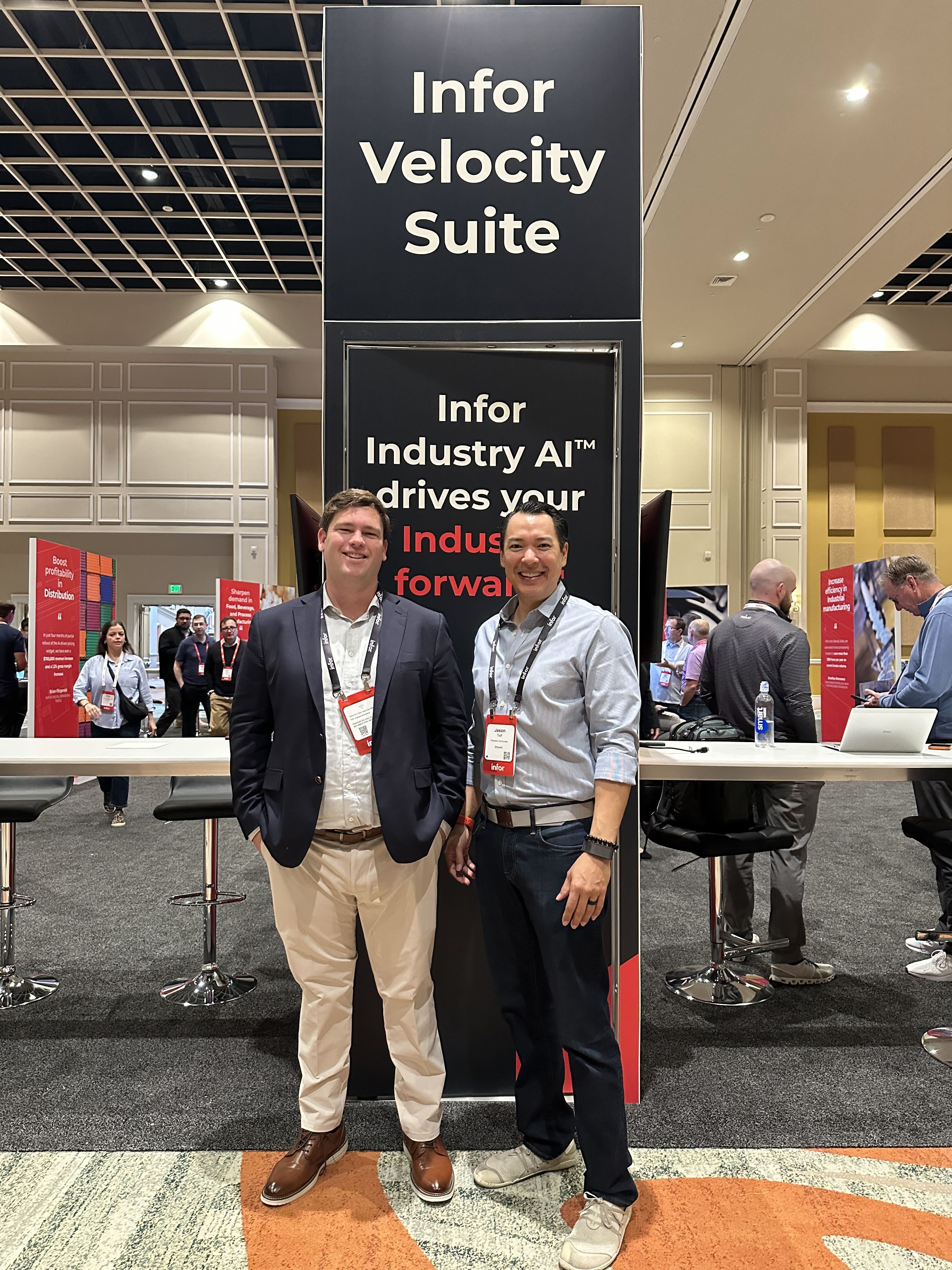
The same stat anchored Velocity Week last year. The difference this time is that Infor spent three days in Orlando showing what it takes to change it. Greg Price, Jason Traff, Jonathan Xiu, and Troy Simpson attended as a sponsor of Infor’s largest learning event, with 140+ sessions across industry, product, and technology tracks.
Predictably, it rained the entire time, but the demo center stayed packed anyway, with attendees lining up to build their own AI roadmaps. Here's what stood out, and where Infor's direction lines up with the AI we're building for transportation.
Precision Starts With Industry Context
Generic AI gives generic answers, and supply chain decisions rarely have generic answers. Infor's keynote example was a candy maker checking Halloween demand. A generic model compares demand to inventory and says you're covered.
An industry-aware model also weighs a retailer's must-arrive-by date of Oct. 15, stock already promised to other retailers, short-notice orders, and promotions. Once those are in, the company is short and needs to shift production.
Infor builds that context into an ontology, a common AI term for a map of how a business fits together. It knows which warehouses hold an item, which plants make it, which customers buy it, and that “plant” and “factory” mean the same thing. Infor compared it to knowing exactly which page of a book has the answer, so the AI doesn’t have to read all thousand pages.
Transportation has its own version of this problem. A late truck means one thing for a just-in-time production line and something entirely different for a replenishment order with a week of buffer. Between sessions, a manufacturer running Infor told us carrier delays rippling into production are their biggest headache, and watching Infor’s AI flag parts shortages before they hit the production schedule felt “built for us.”
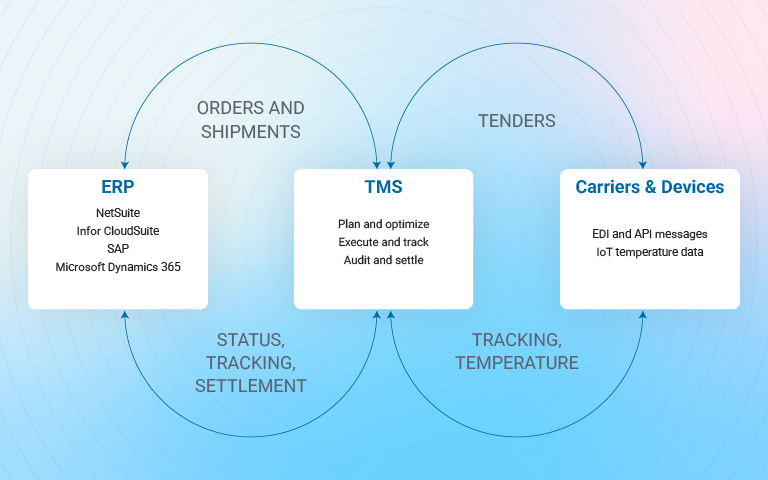
To spot those shortages, Infor’s agent pulls supplier ASNs, EDI shipping schedules, and lead-time history through Infor ION. Shipwell’s Infor integration runs on that same layer, keeping carrier assignments, tracking events, and delivery confirmations in sync with CloudSuite in both directions.
Inbound freight is where many of those shortages start. Shipwell's Track & Trace AI Worker monitors shipments in transit around the clock, contacts carriers when tracking goes missing, and flags delays while there's still time to react.

AI Belongs Where the Work Happens
Plant supervisors walk the floor and logistics teams rarely sit on one screen all day, so AI has to reach people wherever they work. Infor's goal is for 95% or more of users to never log into an ERP screen. Not one ERP screen appeared in any keynote demo.
Attendees lit up at that idea more often than we expected. Several asked how Infor's Copilot and Claude integrations, launched in October, would work with the AI tools their teams already use every day.
We’ve been building toward the same idea on the transportation side. Shipwell is creating a system of action, where AI monitors freight, decides what needs to happen, and executes inside the workflows teams already run. Shipwell AI Studio is where that work happens today, giving teams one place to activate AI Workers and the In-App AI Assistant, set how they behave, and track how they perform.
AI Studio’s advantage is context. It works from each shipper’s own shipments, carriers, contracts, and rules inside Shipwell, so its recommendations and actions reflect how that specific business runs. Through our MCP Server, that same context reaches AI assistants like Claude, GPT, and Gemini and works alongside ERP and WMS systems.

Governance Makes AI Worth Trusting
An agent that gives a different answer every time you ask won't make it past its first audit. Infor showed this live, asking its material shortage agent "what are my shortages this week?" twice. The second answer matched the first, updated to show one item fixed and four remaining.
Infor compared the setup to a car: the LLM is the engine, and governance is the brakes. Its agents get managed identities and time-bound access like any user, their reasoning is visible, and Infor says customer data isn't used to train models.
Data governance was one of the top questions attendees brought to us, especially whether their data ever trains a model. Shipwell’s answer is no. We have never used customer data, including aggregated or de-identified data, to train or fine-tune any AI model, and the approved AI providers we work with are contractually barred from training on it too.
The rest of our AI commitments cover the questions that usually come next:
- AI capabilities working for one customer can’t access another customer’s data
- Customer data is processed only by enterprise-grade AI providers, never consumer AI services
- Customers can turn AI capabilities on or off without affecting the core platform
- AI agents can use only the tools, data, and actions explicitly granted to them
- Every action an AI agent takes is logged for monitoring, troubleshooting, and review
Speed to Value Is Now Measured in Weeks
Waiting two to three years for AI to pay off is over, and Infor made speed its fifth design principle. Having Aston Martin CIO Steve O'Connor on stage gave that point a little extra horsepower. He described his parts shortage problem in plain English, and a seven-use-case AI roadmap landed in his inbox in about 30 seconds.
The moment caught even some of our team off guard. Infor also shared that its Velocity Suite catalog has passed 500 industry-specific use cases, up from 10–20 per industry at launch, and deployment has dropped from about 12 weeks to about three per use case.
The most common question at the demo center was how fast a prototype could reach production in a customer's own environment. Infor's answer is a new capability that lets business users describe a problem, generate a prototype in their own tenant, and refine it in plain language. Shipwell works from the same principle: teams configure AI Worker behavior, communication, and permissions themselves.
Speed matters for freight, too. Another manufacturing customer told us early warning on inbound freight could cut what they spend on expedited shipping every quarter. At Airlite Plastics, the Track & Trace AI Worker paid off right away, handling about 98% of the tracking updates the team used to do by hand. Our Infor integration moves at the same pace, with most teams going live in weeks using pre-built data mappings.
What Industry Forward Means for Shippers on Infor
One conversation captured where transportation fits: another manufacturing team walked us through using agents to rebalance inventory across locations before a truck ever needs to be rushed.
ERP agents decide what needs to move. Transportation data decides whether it can move on time and at what cost. Here's how Infor's principles line up with Shipwell's AI today.
Running Infor CloudSuite and want transportation data your AI can use? Talk with us about adding transportation to your CloudSuite environment.
Frequently Asked Questions
What was Infor Velocity Week 2026?
Infor Velocity Week 2026 was Infor's largest learning event, held Oct. 6–8, 2026, at Rosen Shingle Creek in Orlando, Florida. It brought together 140+ sessions across seven product tracks, industry-specific sessions, technology workshops, and executive keynotes. Business leaders, product power users, admins, and technical teams attended to align on AI strategy and execution. Shipwell attended as a sponsor, with Greg Price, Jason Traff, Jonathan Xiu, and Troy Simpson representing the team.
What did Infor focus on at Velocity Week 2026?
Infor focused on closing the gap between AI investment and measurable value. Its keynote laid out five design principles: precision through industry context, a connected ecosystem, usability, governance, and speed. Infor showed its industry ontology, a map of how a business’s products, plants, and customers connect, Copilot and Claude integrations, consistent agent answers, and a capability for customers to build AI prototypes in their own tenant. It also reported a catalog of 500+ industry-specific use cases.
How does Shipwell work with Infor CloudSuite?
Shipwell’s Infor integration is built on Infor OS and Infor ION, giving CloudSuite a live, bi-directional connection to Shipwell’s TMS without custom scripts or middleware. Orders, item master data, shipment numbers, carrier assignments, tracking events, delivery confirmations, and closure status stay in sync between the two systems. The integration supports both API and EDI, and most teams go live in weeks using pre-built data mappings. Shipwell is available through the Infor Marketplace or directly through Shipwell’s sales team.
Which AI tools can connect to Shipwell's MCP Server?
Shipwell's MCP Server is compatible with leading AI models and frameworks, including Claude, GPT, Gemini, LangChain, and CrewAI. It gives approved AI assistants secure access to shipments, carriers, contracts, rates, dock schedules, invoices, and exceptions. The server is read-only by default, with write actions such as creating a shipment available on request. It's designed to work alongside ERP and WMS systems so one assistant can reason across platforms.
How does Shipwell keep AI secure and auditable?
Shipwell is SOC 2 compliant and uses role-based access control across its AI capabilities. The MCP Server enforces permissions on the server side and limits AI access to each customer's own environment. Every AI Worker action is logged in a complete audit trail, and teams control worker behavior, communication channels, and operating parameters. The Track & Trace AI Worker escalates to people only when a decision needs human judgment.