.svg)


The Best Transportation Management Software for ERP-Connected Multimodal Shippers

Key Takeaways

- A TMS that claims ERP integration and one that keeps NetSuite or Infor CloudSuite in sync are often different platforms; ask whether the connector is certified or custom
- Multimodal shippers need mode transitions to run through the same ERP record, not a separate system per mode
- Oracle OTM, Blue Yonder, e2open, and Infios each handle ERP integration differently; the right fit depends on your ERP and how many modes you run
Most logistics teams start looking for transportation management software for one of two reasons: their current TMS no longer keeps up, or they don't have one yet. Either way, they want clearer visibility into what's moving, what it costs, and where it's running late.
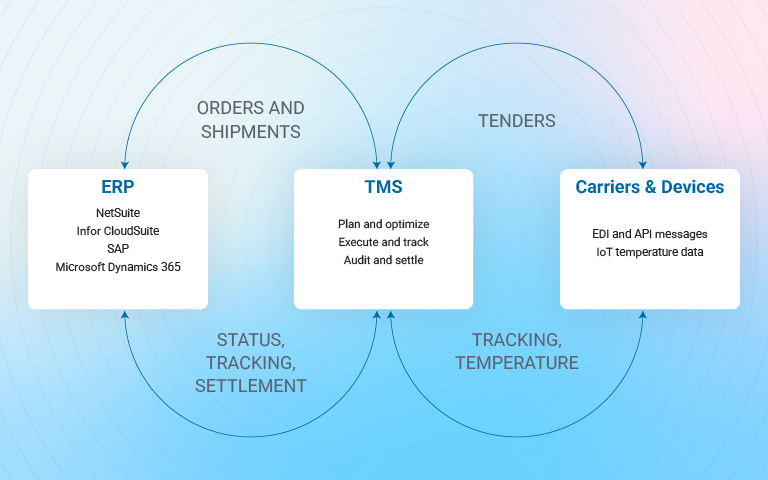
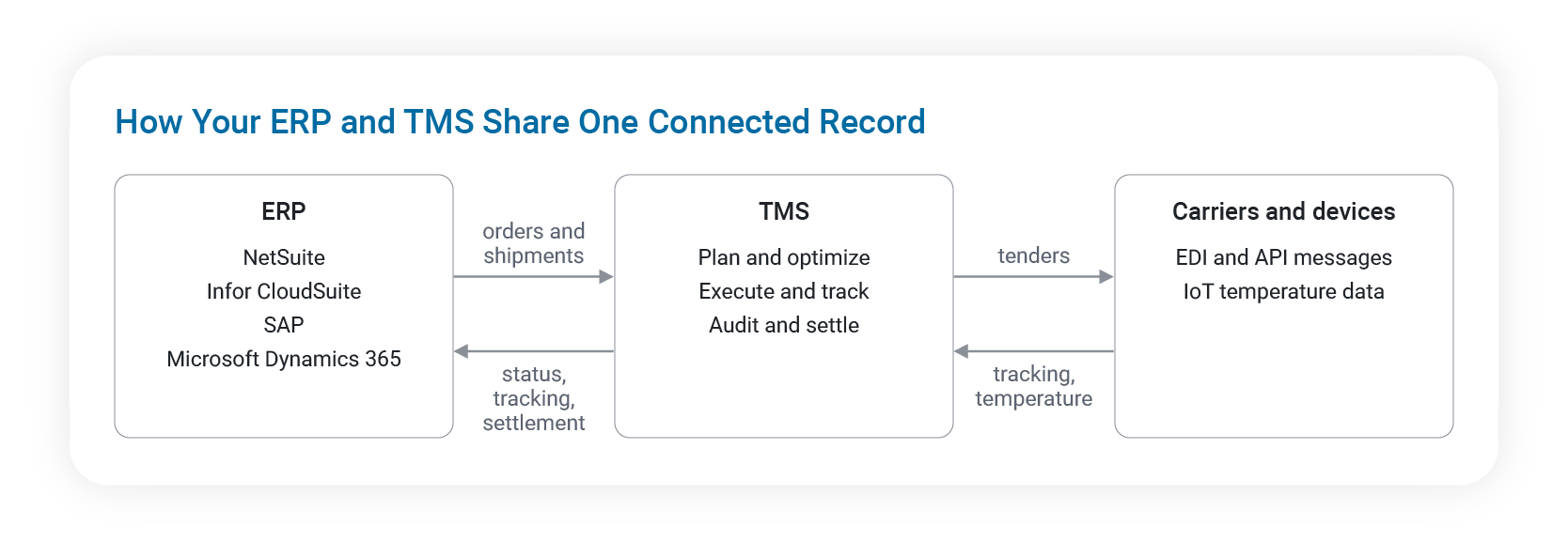
That visibility depends on the TMS actually talking to your ERP, and most platforms claim to do exactly that. The real test is whether both systems work off a single shared record, not two separate ones your team has to reconcile by hand.
Download Now: Free TMS Platform Evaluation Checklist [Get Your Copy]
This comparison looks at five transportation management platforms built for ERP-connected, multimodal freight: Shipwell, Oracle Transportation Management (OTM), Blue Yonder, e2open, and Infios (formerly MercuryGate). All five operate at enterprise scale, so this article evaluates them on their transportation management capabilities specifically, not the breadth of the broader supply chain suites some of them sell alongside their TMS.
This guide covers:
- 6 things every ERP-connected multimodal shipper should evaluate
- How Shipwell, Oracle OTM, Blue Yonder, e2open, and Infios compare
- How deep a TMS ERP integration needs to go
- Industry-specific considerations
- Questions to ask every TMS vendor
6 Things Every ERP-Connected Multimodal Shipper Should Evaluate
A transportation management platform earns its place in an ERP-connected, multimodal operation on six fronts.
1. ERP integration depth
Whether orders, shipments, tracking, and freight costs move between the TMS and the ERP without re-keying, and whether that connection is a certified product or a custom build your IT team owns. Orders and shipment details flow from the ERP to the TMS, and status, tracking, and settlement data flow back. Without that shared record, transportation teams decide on partial information, and the cost shows up as missed margin and invoices nobody can trace back to an order.
2. Multimodal coverage in one workflow
Multimodal freight management is more than a features list: a platform that lists every mode on its website and one that plans, tenders, and settles multiple modes through a connected workflow are not the same thing. A single order can move by truckload, drayage, ocean, and LTL before it reaches its final destination, creating multiple handoffs that still need to tie back to the same order and financial record. Whether planners can manage the full movement as one connected workflow via consistently synched transportation & ERP data without manual reconciliation - that’s the real test.
3. Freight audit and settlement synced to the ERP
A platform that matches invoices to shipments but still requires someone to manually re-key the result into the ERP has not solved the problem. Audit and settlement should sync back through the same ERP connection described in the section below, not a separate export or manual entry step. The test question for any vendor: when a carrier invoice disagrees with the ERP record, does the platform flag it automatically, or does someone have to notice it first?
4. Implementation timeline and carrier onboarding
Timelines vary widely by platform, ERP complexity, and how much custom integration work is involved; the comparison table below has estimates for all five platforms in this review. Carrier onboarding is often the bigger variable than the software itself, since EDI setup can take 2 to 8 weeks per carrier. The useful question beyond timeline is how much of it your own IT team carries versus how much a certified, pre-built connector removes from the critical path.
5. Industry-specific requirements
General-purpose evaluation criteria won't catch every vertical's failure points, whether that's a compliance requirement, a routing pattern, or a multimodal network specific to how one industry moves freight. Manufacturing, CPG, and food and beverage shippers each hit these points at different times, whether that's a production delay, a rejected pallet, or a temperature excursion, and left unmanaged the result is spoiled product, chargebacks, and margin that disappears before anyone traces it back to a cause. Industry-specific requirements deserve their own line item in a TMS evaluation.
6. AI and automation that acts
Most TMS platforms now include some form of AI, but there's a meaningful difference between AI that surfaces information and AI that takes action within defined guardrails. Ask what operational data the AI can access, what's available in production today, what the AI actually does, where humans stay in the loop, and what measurable results customers are seeing. A vendor that can't answer clearly is telling you the AI is more feature name than functional workflow.
How Do Shipwell, Oracle OTM, Blue Yonder, e2open, and Infios Compare?
ERP connector depth, mode coverage, and implementation timeline vary across these five platforms, based on public documentation. All five operate at enterprise scale, so the table covers transportation management capabilities only, not the wider supply chain suites some of them sell.
Not every vendor publicly discloses the same level of detail about integrations, implementation timelines, or other capabilities. Where information isn't available directly from the vendor, we've marked it as "not disclosed" or used third-party sources where noted, based on the best publicly available information at the time of this review.
How Deep Does a TMS's ERP Integration Need to Go?
Deep enough that orders, shipments, tracking, and freight costs move between the TMS and the ERP without re-keying. Pre-built, certified connectors generally get there with less implementation work and less ongoing ownership on your side. Custom or middleware-based integrations can reach the same depth, but they usually take more scoping, testing, and maintenance to do it, and your IT team carries more of that work for the life of the contract.
Shipwell takes the certified-connector path for NetSuite and Infor CloudSuite, and connects to other ERPs through API. Here's how that compares against two platforms that take different approaches: Infios, which also leans on pre-built connectors, and Blue Yonder, which relies more on middleware.
Where Do Oracle OTM and e2open Stand?
Oracle Transportation Management's (OTM) integration documentation lists only its own ERP family, Oracle Fusion Cloud and E-Business Suite; no NetSuite connector is documented, despite Oracle owning NetSuite. OTM does go deeper than any other platform in this comparison inside that Oracle ERP family. e2open connects to NetSuite and Infor through open API and EDI, confirmed bidirectional by ERP Research, though without a named, certified connector for either.
Shipwell vs. Infios (MercuryGate) on ERP Integration
Shipwell holds "Built for NetSuite" status, announced April 2023, with a SuiteApp that syncs orders, shipment details, status updates, and tracking links, and is an official Infor Partner Network member with direct API integration to Infor's ERP and CloudSuite. Infios lists a pre-built NetSuite connector and a documented alignment with Infor's supply chain execution and ERP applications, though not a named CloudSuite certification.
Both platforms take the pre-built-connector approach; the difference is that Shipwell holds named certifications for both target ERPs, while Infios' Infor relationship is a documented alignment rather than a formal certification. Infios does list the broadest set of pre-built ERP connectors of any platform in this comparison, a fair advantage on breadth.
Shipwell vs. Blue Yonder on ERP Integration
Blue Yonder connects natively to SAP and Oracle, but reaching NetSuite requires its MuleSoft-powered middleware layer rather than a certified, pre-built connector, and no Infor CloudSuite connector is documented. A middleware layer is not inherently a dealbreaker, but it does add a system to implement, test, and maintain over time, work that a single certified connector generally absorbs. Shipwell's SuiteApp and Infor Partner Network membership skip that extra layer for NetSuite and Infor CloudSuite specifically.
A note on SAP and Microsoft Dynamics 365
SAP and Microsoft Dynamics 365 support is close to table stakes across this competitor set. Shipwell connects to SAP through API and EDI and delivers Dynamics 365 through certified partner NMB Solutions, while e2open lists a certified SAP marketplace app.
Industry Considerations
ERP integration and multimodal coverage matter across manufacturing, CPG, and food and beverage, but each industry hits a different failure point first. Here's what to weigh by vertical.
Manufacturing
Manufacturing transportation systems have to keep pace with production schedules that don't pause for freight exceptions. A single order at a manufacturer might move by truckload from the plant, drayage to a port, ocean to a distribution hub, and LTL to the final delivery, with raw material inbound and finished goods outbound often running on the same multimodal network. Manufacturing ERPs lean heavily on SAP and Infor CloudSuite, which is part of why a certified connector for Infor CloudSuite matters here specifically: production schedules, purchase orders, and shipment data need to stay in sync without a manual bridge between systems.
Food and Beverage
Temperature-confrolled food and beverage logistics fails differently than dry goods freight. A missed delivery window at a grocery distribution center often means a rejected load, and a temperature excursion can mean rejected product. Shipwell's IoT partnerships bring real-time tracking and temperature monitoring into the TMS, so an excursion becomes a documented exception before it becomes a claim.
None of the other four platforms in this comparison publishes food and beverage cold chain features as prominently as its multimodal and ERP capabilities. Ask any vendor how temperature and pressure data reaches the platform, and how an excursion flows into the ERP.
Consumer Packaged Goods (CPG)
CPG shippers run high SKU counts, frequent replenishment, and tight retailer delivery windows, so freight planning and optimization for infrequent, large shipments does not carry over. Shipwell's Load Optimization module consolidates orders by size, weight, location, and delivery window, paired with automated routing guides. e2open, Infios, and Oracle OTM each offer load consolidation and routing rules, and Oracle OTM's planning module is one of its deepest capability areas.
What Should You Ask Every TMS Vendor Before You Decide?
These ten questions cut across every part of the framework above, grouped by where they fit in a typical evaluation. Ask them of every vendor, and treat a vague answer as an answer.
Technical fit
- Is the ERP connection a certified product connector or a custom project, and which fields sync in each direction?
- Does the vendor hold a named, certified connector for your specific ERP, or a generic "we integrate with ERPs" claim?
- Is data synced bidirectionally, or one-way, so a discrepancy gets flagged automatically instead of someone finding it later?
- Does the ERP see one shipment record per order, or one per mode, when a shipment splits across truckload, LTL, drayage, or ocean?
Proof and validation
- Can you get a live demo of the integration against your own data, not a slide deck?
- What can the platform's AI actually do on its own versus recommend for a person to approve?
- What guardrails can you configure around AI actions, and can the vendor show documented results from those capabilities running in production?
Operational fit
- Who owns this ERP connection after go-live: your IT team, the vendor, or a third-party implementation partner?
- How does the platform handle the requirements specific to your industry, whether that's cold chain visibility, high-SKU routing, or plant-to-port multimodal moves?
Commercial
- What's the all-in cost, including license, implementation, and integration work, itemized rather than bundled?
Get Started
Don't evaluate a TMS on feature count alone. Look at how deeply it connects to the systems you already run, whether it can manage your modes in one workflow, how much manual work remains between execution and settlement, how well it fits the requirements of your industry, and what its AI can actually act on.
If your team is evaluating transportation management software for an ERP-connected, multimodal environment, request a demo to see how Shipwell stacks up against the other platforms on your shortlist, using your own ERP and mode mix.
Frequently Asked Questions
Does Shipwell integrate with NetSuite?
Yes. Shipwell's TMS SuiteApp holds "Built for NetSuite" status, announced in April 2023. It syncs orders, shipment details, status updates, and tracking links between NetSuite and Shipwell, so teams can rate, tender, track, and reconcile freight without leaving the ERP record.
Does Shipwell connect to Infor CloudSuite?
Yes. Shipwell is an official member of the Infor Partner Network, and its TMS connects directly to Infor's ERP and CloudSuite through API. Transportation data such as orders, shipment status, and delivery updates flows into Infor without manual entry.
Which other ERP systems does Shipwell support?
Shipwell integrates with SAP, Oracle, and Microsoft Dynamics 365 through real-time APIs, flat files, SFTP, and EDI.
Do Oracle OTM, Blue Yonder, e2open, and Infios integrate with NetSuite and Infor CloudSuite?
Depth varies. e2open and Infios connect to NetSuite and Infor through open APIs or pre-built connectors without a named certified connector, while Blue Yonder reaches NetSuite only through middleware. Oracle OTM's public documentation lists only Oracle's own ERP family, with no documented NetSuite connector despite common ownership.
What is the best transportation management software for multimodal freight?
The right platform depends on which modes and ERP you run. Shipwell, Infios, and e2open each support truckload, LTL, intermodal, and ocean freight, while Oracle OTM adds deep multi-leg optimization for enterprise networks. Compare platforms on whether every mode lands in the same ERP shipment record.
What should food and beverage shippers look for in a TMS?
Food and beverage shippers look for temperature and pressure monitoring built into shipment visibility, dock scheduling and delivery-window management that reduces rejected loads, and a clear path for excursions to reach the ERP. IoT data should arrive in the platform in real time, not through a separate system that needs manual cross-checking.
How does AI in a TMS depend on ERP integration?
AI only works as well as the data it can reach, so ERP integration comes first: an AI that can't read live order, shipment, and settlement data from the ERP is limited to recommendations, not action. The strongest proof isn't a list of potential use cases, it's documented results. At Airlite Plastics, Shipwell's Track & Trace AI Worker automates roughly 98% of tracking updates, cutting the time its team spends chasing carrier updates from four to five hours a day to about one.