.svg)


Compare TMS Providers in the Latest Gartner® Magic Quadrant™


Key Takeaways

- The Gartner® Magic Quadrant™ for Transportation Management Systems is not a stack ranking; but an evaluation of vendors in the TMS industry. Effective evaluation requires balancing a provider’s current Ability to Execute with their Completeness of Vision for future automation.
- The TMS market is transitioning from passive visibility (tracking delays) to active execution (automatically resolving them). Modern logistics leaders are prioritizing "systems of action" that eliminate manual workflows.
- Choosing the right provider depends on organizational maturity. While Leaders offer proven legacy scale, Visionaries like Shipwell provide the native-cloud architecture and AI-driven automation necessary for rapid ROI and reduced operational overhead.
The Gartner® Magic Quadrant™ for Transportation Management Systems (TMS), in our opinion, serves as a strategic map for market evolution. It’s not an award or ranking, but rather an evaluation of vendors in the TMS industry. Selecting the right TMS requires balancing current operational execution with a provider’s long-term vision for automation and AI-driven efficiency.
How Does the Gartner Magic Quadrant Work?
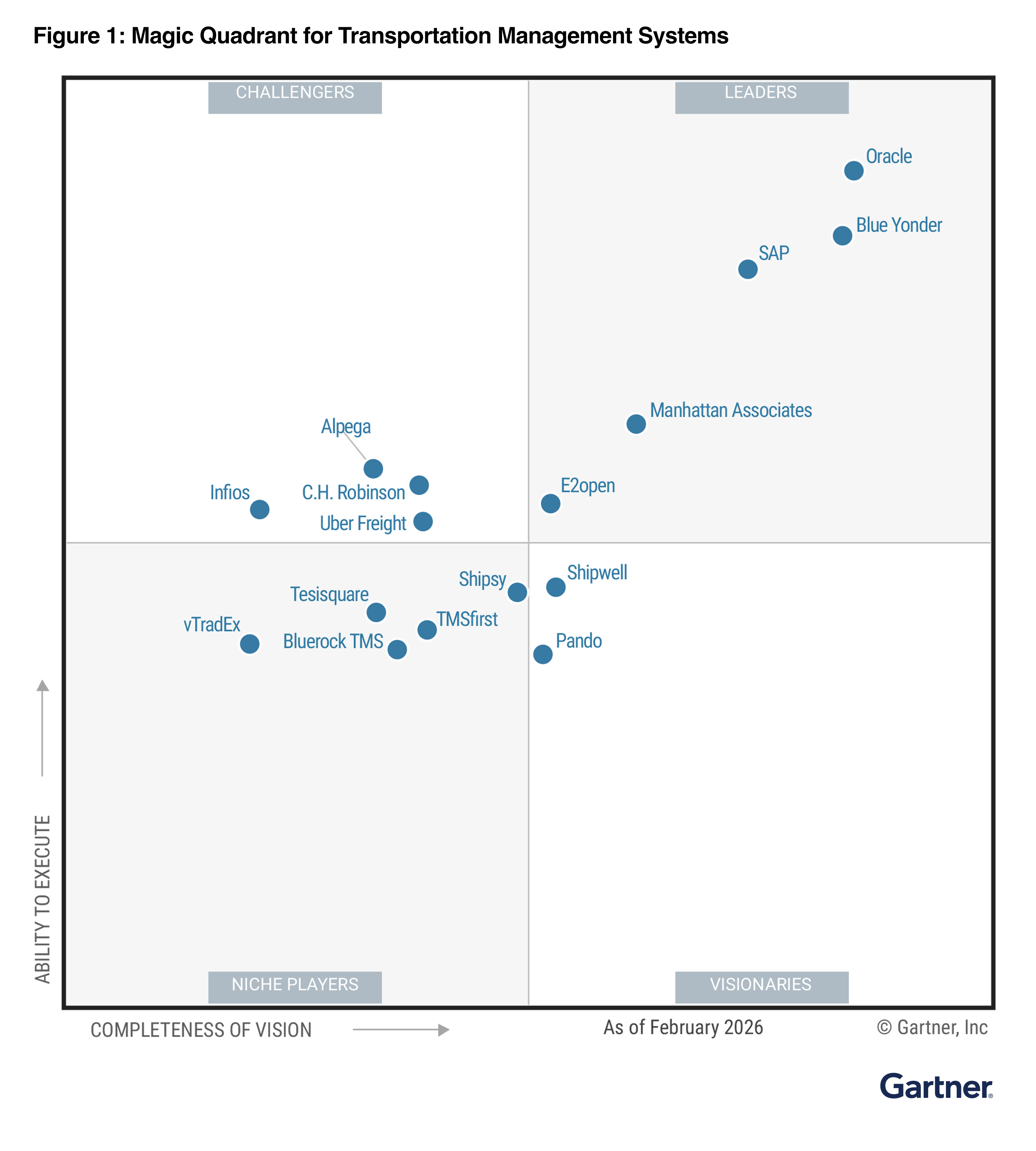
A Magic Quadrant provides a graphical competitive positioning of four types of technology providers, in markets where growth is high and provider differentiation is distinct. High-growth markets require a TMS provider comparison of how industry players adapt to automation,AI and rising speed expectations.
To actually assess TMS providers, you have to read it the way Gartner intends: as a balance between what works today and what’s coming next.
What Are the Two Primary Forces Behind Every Placement?
Gartner evaluates vendors based on "Ability to Execute"(current performance) and "Completeness of Vision" (future roadmap).Understanding the tension between these two axes is critical for long-term ROI.
At the heart of the Magic Quadrant are two core metrics:
- Ability to Execute: Gartner analysts evaluate vendors on the quality and efficacy of the processes, systems, methods or procedures that enable provider performance to be competitive, efficient and effective, and to positively affect revenue, retention and reputation.
- Completeness of Vision: Vendors are evaluated on their ability to convincingly articulate logical statements about current and future market direction, innovation, customer needs and competitive forces.
Every vendor is positioned based on the intersection of these forces.
How Is the TMS Market Currently Transitioning?
The industry is moving from passive visibility ("Where is my freight?") to active autonomous execution("The shipment is handled"). Modern systems now absorb manual tasks like exception management.
For decades, TMS platforms were judged on visibility. Seeing a delay was the goal. Today, visibility is the baseline. The market is shifting decisively toward autonomous action. The gap is widening between systems of record that require human intervention and systems of execution that resolve disruptions automatically.
What Are the Differences Between Leaders and Visionaries?
As defined by Gartner:
Leaders have the ability to execute their vision through their TMS products and demonstrate solid business results in the form of revenue and customer growth. Leaders have significant successful customer deployments in a wide variety of industries, across multiple geographies, and with multiple proofs of deployments. They offer functionally rich solutions that are especially beneficial to larger organizations with a high level of transportation complexity. Leaders should be able to support global transportation operations and are often the vendors against which other providers measure themselves.
Visionaries are typically seeking to deliver a unique or differentiated approach to the market. They may be considered thought leaders and tend to be on the leading edge of emerging concepts and technologies. Visionaries may have a smaller number of live customers and/or lack a substantial market presence. These vendors usually have deficiencies in their Ability to Execute, particularly in areas such as market visibility, growth, track record or operations. Vendors in this category can be established TMS vendors that have yet to mature into leading positions in the market, or they can be innovative vendors that are more specialized, with unique views of where the market is heading.
Where Does Shipwell Fit, and Why Does It Matter?
Shipwell’s placement as a Visionary, in our minds, on the latest Gartner Magic Quadrant for Transportation Management Systems report reflects a distinct approach to freight operations. We believe Shipwell was named a Visionary because our platform combines more traditional TMS capabilities with visibility and workflow automation.
Instead of treating the TMS as a passive monitor, Shipwell is built to act. And in 2026, you can expect more of the following:
- AI-powered Automation: Building off the success of our Track & Trace AI Worker for agentic shipment tracking, coming soon are our new Settlement Worker to help match invoices to shipment data for faster processing, and the Shipwell MCP Server – our AI-native integration layer that allows agents to work across the various platforms you already work within.
- Increasingly Rapid Deployment: Unlike legacy platforms requiring 12-months of intense operations & IT involvement due to rigid technology architecture and outdated implementation models, Shipwell targets accelerated value delivery. To achieve maximum ROI out the gate, our implementation timeline averages 12 weeks.
- Philosophical Shift: We don't aim for efficient manual work; we aim for the elimination of it through predictive logistics. Using AI to analyze patterns in historical data and forecast future supply chain events across our customers’ entire shipping network, the platform identifies risks and opportunities before impacting operations.
How Should You Actually Compare TMS Providers?
Selection should depend on your operational maturity. If massive global scale is the only priority, a Leader is suitable; if operational speed and reduced overhead are the goals, a Visionary is often the better choice.
We feel the Gartner Magic Quadrant for Transportation Management Systems assists in narrowing the field, but it does not dictate the final decision. The right market vendor among those evaluated depends on your specific KPIs. In our opinion, you should consider:
- For Stability: Prioritize "Ability to Execute" if you have deeply embedded, static processes that require massive scale.
- For Speed: Prioritize "Completeness of Vision" if you need to reduce headcount-heavy workflows and adapt to market volatility.
The quadrant isn’t meant to be viewed as a hierarchy. It’s a map.
How Should Executives Finalize Their TMS Strategy?
Comparing TMS providers is about recognizing the industry's trajectory. The future of logistics is execution, and the most valuable partners are those doing the work, not just reporting on it.
If you want to dig deeper into how Gartner evaluates the market, and where each provider stands, download the latest Gartner Magic Quadrant for Transportation Management Systems for the full breakdown.
{{divider}}
Objectivity Disclaimer
Gartner, Magic Quadrant for Transportation Management Systems, By Brock Johns, Oscar Sanchez Duran, Manav Jain, 30 March 2026. Gartner and Magic Quadrant are trademarks of Gartner, Inc. and/or its affiliates. Gartner does not endorse any company, vendor, product or service depicted in its publications, and does not advise technology users to select only those vendors with the highest ratings or other designation. Gartner publications consist of the opinions of Gartner’s business and technology insights organization and should not be construed as statements of fact. Gartner disclaims all warranties, expressed or implied, with respect to this publication, including any warranties of merchantability or fitness for a particular purpose. This graphic was published by Gartner, Inc. as part of a larger research document and should be evaluated in the context of the entire document. The Gartner document is available upon request from Shipwell.
Frequently Asked Questions
What is the Gartner Magic Quadrant for TMS?
The Gartner Magic Quadrant for Transportation Management Systems is a report. A Magic Quadrant provides a graphical competitive positioning of four types of technology providers, in markets where growth is high and provider differentiation is distinct: Leaders, Visionaries, Niche Players and Challengers. It serves as a tool for shippers to compare technology partners in a complex environment.
How does Gartner evaluate these providers?
Gartner evaluates vendors based on their "Ability to Execute" and "Completeness of Vision." This ensures providers are measured both on their current product viability and their long-term strategic roadmap.
What does it mean to be a Visionary in the Magic Quadrant?
Visionaries understand where the market is going or have a vision for changing market rules, but do not yet execute well.
Is a Leader always the best choice for enterprise TMS?
Keep in mind that focusing on the Leaders quadrant isn’t always the best course of action. There are good reasons to consider market challengers. And a visionary may support your needs better than a market leader. It all depends on how the provider aligns with your business goals.
How should I use the Gartner Magic Quadrant in my TMS evaluation?
Use a Gartner Magic Quadrant report as a first step to understanding the technology providers you might consider for a specific investment opportunity. By applying a graphical treatment and a uniform set of evaluation criteria, a Magic Quadrant can help you in quickly ascertaining how well technology providers are executing their stated visions and how well they are performing against the Gartner market view.
Where was Shipwell positioned in the 2026 TMS Magic Quadrant?
Shipwell was named a Visionary in 2026, which we believe reflects our focus on building a modern, automated approach to transportation management. Our platform is engineered to reduce manual overhead and help teams operate more efficiently.
What trends are shaping the future of TMS?
The primary trend is the transition from "visibility" to "autonomous execution." AI and automation are no longer optional add-ons; they are becoming the standard for resolving real-time shipping disruptions worldwide.
How do I choose the right TMS provider for my business?
Identify your primary bottleneck. If it is manual work and slow response times, look for a provider with a high "Completeness of Vision." If it is purely about managing 50,000+ global shipments with legacy processes, look toward the Leader quadrant.