.svg)


How to Build a Logistics AI Strategy That Actually Sticks

Key Takeaways

- AI is the insight engine, automation the worker. Understanding the difference between these two is hindering tech adoption.
- High-ROI strategies use AI Workers for process-based tasks to free up human talent for exception management.
- Successful strategies prioritize a "sandbox-first" approach and read-only integrations to prove value before granting write-access to the system of record.
Board mandates to implement AI often leave logistics leaders with dangerously vague directives. Without a clear framework defining what AI actually executes for your freight, you risk funding expensive pilots that don't reach production.
Learn how to build an enduring strategy by separating initiatives into internal efficiency and external interface pillars.
Separating AI From Automation
Combining probabilistic insights with rule-based automation creates a balanced logistics framework.
The primary hurdle in adoption is the lack of a clear definition. Your strategy must deploy two distinct operational “brains” to avoid wasting resources on ineffective technology pilots. Those are:
- AI (aka, the insight engine): Probabilistic. It excels at scanning thousands of lines of data–like 30,000 shipment loads–to find patterns, anomalies, or why a process is failing.
- Automation (aka, the worker): Deterministic. It follows a set of rules perfectly–like a worker that identifies if a document is a valid POD and automatically attaches it to a shipment.
Using a "probabilistic" chatbot to handle a "deterministic" financial task means errors abound. Using rigid automation to find hidden data trends delivers zero results. A successful strategy uses both.
Internal Efficiency & Overhead (Pillar 1)
Internal AI workers eliminate repetitive tasks to protect profit margins and free up human strategy.
You can build leaner operations by targeting tasks that cause team burnout and manual errors. AI can help your team with:
- Exception Management: Instead of a human checking every load, AI "workers" flag only the shipments that deviate from the norm–such as a driver missing a geo-fence or an invoice that doesn't match the quote.
- Document Intelligence: We are moving toward a world where no human should have to manually type data from a PDF into a TMS. AI should parse, classify, and validate every document that enters your ecosystem.
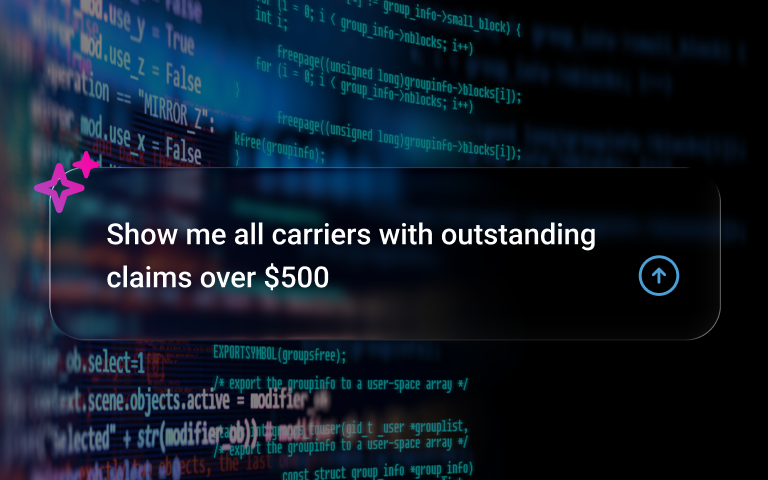
- Support & Finance: Using tools like the Shipwell MCP server, your finance team can query data in natural language ("Show me all carriers with outstanding claims over $500") rather than waiting for a custom report from IT.
External Customer Impact (Pillar 2)
External AI accelerates communication response times to capture market demand and secure revenue.
An example of how this might play out for a specific industry might be: in building materials or manufacturing, your product might not be considered high-tech, but your service must be. By granting AI access to connect directly to customers, you can increase:
- Speed to Quote: The first person to quote often wins the business. AI can monitor your inbox, extract quote requests, and feed them into your rating engine instantly.
- Proactive Visibility: Moving from "Where is my truck?" to "Your truck is delayed, and here is the adjusted ETA." This shift reduces the "noise" of customer service inquiries.
- Capturing Lost Data: Most companies lose 30-40% of their market data because quote requests stay trapped in email threads. External AI captures that data, giving you a map of exactly where you are winning and losing.
Comparing Internal vs. External AI Strategy
Balancing internal operational goals with external customer demands requires tracking distinct metrics.
How To Execute a Low-Risk Implementation
A sandbox-first path proves technological value in a read-only environment before risking production disruptions.
By connecting your data via the Shipwell MCP server in a read-only environment, you can test without affecting live freight. Additionally, you can prove that the AI can identify cancellation patterns before giving it write-access. We provide more than software; it's a system that executes safely.
Get Started Building Your Logistics AI Strategy
- Separate probabilistic insights from deterministic rules to avoid processing errors
- Deploy internal AI workers to eliminate manual PDF data entry and automate exceptions
- Capture trapped inbox data to accelerate speed to quote and boost win rates
- Utilize a read-only sandbox environment to prove technical ROI within 48 hours
The goal isn't to build the most "complex" AI strategy; it’s to build the most useful one. Start by defining your pillars, identify your manual tasks, and let the technology work for you–not the other way around.
Frequently Asked Questions
What is the "Model Context Protocol" (MCP) and why does it matter for my strategy?
MCP is the secure bridge that allows AI to "see" your logistics data. Without it, an AI is just a generalist. With the Shipwell MCP server, the AI becomes a logistics expert that understands your specific shipments, carriers, and lanes.
How do I choose between AI and automation?
If the task requires a "yes/no" or "if/then" logic (like filing a document), use deterministic automation. If the task requires "finding a needle in a haystack" or interpreting a messy email, use AI. The best logistics AI strategies use both.
Is it safe to connect our ERP to an AI?
Connecting your ERP is completely secure through our architecture. Shipwell utilizes a scoped, read-only integration user during the initial pilot phase. This strict security boundary guarantees the AI can scan your files and provide deep data insights without having permission to alter or delete core corporate financial records.
How do you calculate the real ROI of Document Intelligence?
Financial return is calculated by tracking manual touchpoints per load. Every single freight document that our system automatically parses and validates saves your team 5 to 10 minutes of manual labor. Scale that across 30,000 loads annually, and you redirect thousands of operational hours toward profitable human strategy.
How long does it take to see results?
Measurable results materialize almost instantly during implementation. By utilizing the Shipwell MCP server inside a protected sandbox environment, your operations team can uncover its first high-value use case within 48 hours of initial setup. This rapid validation proves operational value before you ever touch a live production system.