.svg)


What is an MCP Server? Shipwell Gives Your AI a TMS Brain.

Key Takeaways

- Using an MCP eliminates technical debt by replacing custom-coded middleware with autonomous tool discovery.
- AI moves beyond summarization to active problem solving, taking real-time disruptions and resolving them autonomously.
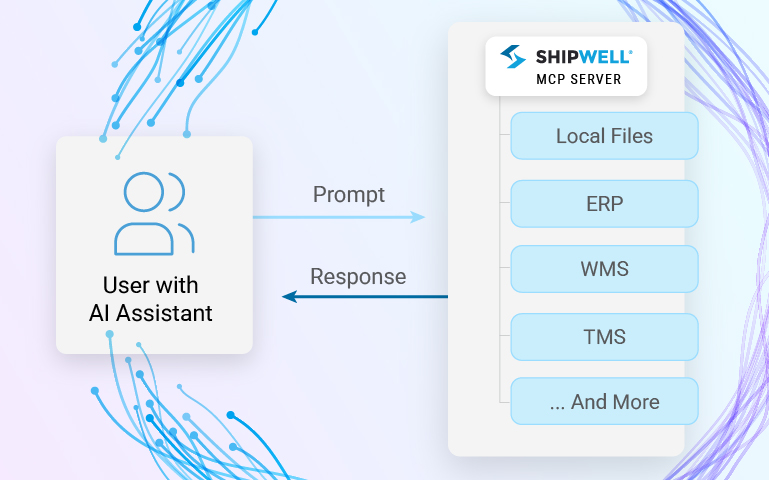
- When connected to an MCP server, one AI assistant can simultaneously reconcile ERP costs, check TMS statuses, and validate WMS schedules.
The Shipwell MCP Server is a production-grade integration layer that enables AI assistants to interact directly with transportation management data through the Model Context Protocol (MCP).
By going beyond static API calls, IT leaders can now provide LLMs with the real-time operational context needed to execute complex logistics workflows. This shift transforms the Transportation Management System (TMS) from a passive system of record into an active, intelligence-driven engine for the entire enterprise.
For years, the logistics industry has faced a "context gap." While AI could summarize text or generate emails, it remained blind to the live data living inside your TMS.
Answering a question as simple as "Which shipments are at risk of missing their window?" required manual data exports or custom-coded middleware. The Shipwell MCP Server eliminates this friction, offering a standardized, secure bridge between your AI assistants and your supply chain.
{{button}}
How does an MCP server transform logistics AI?
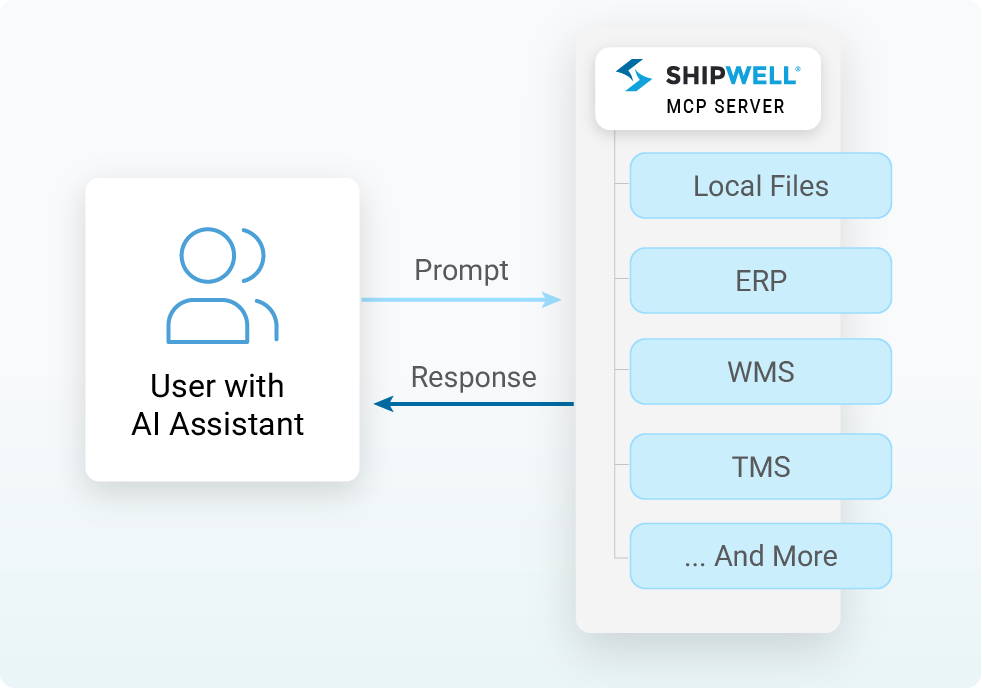
An MCP server acts as a standardized "universal translator" between your AI assistants (like Claude or ChatGPT) and your core enterprise systems. Historically, AI lacked the operational context to answer complex questions because it was siloed from the data within a TMS, ERP, or other system.
The Shipwell MCP Server solves this by creating a secure connection where the AI can discover tools, query live data, and execute workflows without manual data mapping.
Addressing the "Integration Complexity" Objection
One common concern for IT is the potential for increased technical debt when adding AI layers to an existing stack. However, because MCP is a standardized protocol, it simplifies the architecture. Instead of building bespoke REST API integrations for every AI use case, you connect the MCP server once, allowing the AI assistant to automatically understand the schema and available actions.
What Use Cases Does an MCP Server Have?
The Shipwell MCP Server enables complex cross-system coordination that was previously cost-prohibitive to build. By allowing AI to "see" across silos, companies can address volatility before it impacts the bottom line.
- Self-Service Logistics: Resolve everyday order and shipment questions with access to live data across an entire organization.
- Dock Congestion Mitigation: Predict future warehouse bottlenecks by having an AI assistant correlate Shipwell’s dock schedules with live labor data from your WMS.
- Autonomous Exception Management: Empower AI assistants to not only identify a missed pickup but also to suggest alternative carriers based on real-time contract rates and historical reliability.
What Are The Benefits For Shipwell Customers?
Your team no longer has to dig through systems to find answers. Instead, they can ask questions in plain language and get real, data-backed responses instantly. They can more easily understand what’s at risk, where performance is slipping, and what needs attention. The AI assistant can take care of the manual work, so your team focuses on tasks that truly need human attention.
Over time, this changes how work gets done. Teams move faster. Decisions become more proactive. And operations become more efficient. Not because there’s more data (there’s always more data), but because that data is finally usable.
Why Should A Technology Partner Use The Shipwell MCP Server?
Instead of building and maintaining custom API connections, partners can connect once through MCP and immediately gain access to a full set of transportation capabilities, across all major freight modes and workflows.
Partners can combine their own MCP-enabled systems with Shipwell’s in a single AI assistant, creating workflows that span multiple platforms without data syncing or middleware. The result is faster time to market, lower integration costs, and entirely new product experiences built on real-time logistics data.
What Are the Differences Between REST API vs. MCP Server?
For technical teams evaluating the best path for AI integration, understanding the structural differences between traditional API vs. MCP server is critical.
What is the Future of AI in Supply Chains?
The introduction of the Shipwell MCP Server marks a definitive shift in how enterprise logistics systems function. By adopting a standardized protocol for AI integration, Shipwell is ensuring that your TMS is not just a place where data lives, but a tool your AI can actually use to drive efficiency.
Ready to give your AI a TMS brain? If you’re a current Shipwell customer, reach out to your Customer Success Manager to learn more.
If you’re a partner interested in building with Shipwell MCP, connect with our sales team to explore access and integration.
Frequently Asked Questions
What is the Model Context Protocol (MCP)?
The Model Context Protocol is an open standard that allows AI applications to connect with data sources and tools. It replaces the need for custom-coded integrations with a standardized way for AI assistants to "see" and "use" the data within a system like a TMS.
Next Question: How does the MCP server handle cybersecurity and data privacy?
How does the MCP server handle cybersecurity and data privacy?
Shipwell prioritizes secure data management through role-based access controls and audit trails. The MCP server operates within these existing security frameworks, ensuring AI assistants only access data they are authorized to see, mitigating risks of data breaches or compliance violations like GDPR.
Next Question: Will this create more work for my IT team?
Will this create more work for my IT team?
No, the MCP server is designed to reduce technical debt and IT maintenance. Because it uses a standardized protocol, it eliminates the "integration complexity" often found in proprietary tech stacks, allowing for faster deployment with less ongoing support.
Next Question: Does the MCP server replace the Shipwell REST API?
Does the MCP server replace the Shipwell REST API?
Not exactly. While the REST API is designed for system-to-system communication, the MCP server is specifically designed for AI-to-system communication. They work in tandem to provide a comprehensive technical ecosystem for both traditional and agentic workflows.
Next Question: What systems can the Shipwell MCP Server integrate with?
What systems can the Shipwell MCP Server integrate with?
It is built to sit alongside other enterprise systems such as ERPs (e.g., Infor, NetSuite) and WMS platforms. Because MCP is a standard, an AI assistant can simultaneously pull context from a Shipwell MCP Server and an ERP MCP server to provide a unified answer.
Next Question: How do we measure the ROI of an MCP implementation?
How do we measure the ROI of an MCP implementation?
ROI is realized through reduced downtime, improved IT efficiency, and logistics cost savings. By automating manual data consolidation and exception management, teams can focus on high-value tasks, reducing the "total cost of ownership" for the TMS.
Next Question: Can the AI assistant make changes inside the TMS?
Can the AI assistant make changes inside the TMS?
Yes, depending on the permissions granted. The MCP server allows AI assistants to not only query data but also interact with live transportation data to execute specific tasks or updates within the system.
Next Question: How do I get started with the Shipwell MCP Server?
How do I get started with the Shipwell MCP Server?
If you are a current customer, please reach out to our sales team for more information on enabling this feature. If you are a potential technology partner, connect with our sales team to explore access and integration opportunities.
Next Question: What is the next step after implementing the MCP server?
What is the next step after implementing the MCP server?
Once the server is live, the next step is often "agentic orchestration"—setting up autonomous workflows where the AI monitors for specific supply chain triggers and suggests or executes resolutions automatically.
Next Question: What is the Model Context Protocol (MCP)?