.svg)


How To Let AI Find the Problems In Your Operational Data

Key Takeaways

- The greatest operational breakthroughs come from using natural language directives rather than perfectly crafted queries.
- Moving to an AI-driven model allows teams to shift from "defensive" logistics to "offensive" logistics, fixing issues before they become problems.
- The Shipwell MCP server acts as a secure, read-only layer that connects your system of record with your transportation data, allowing for full-lifecycle analysis without compromising security.
The biggest barrier to AI adoption in logistics isn't the technology; it's the "blank page" problem.
Shippers feel pressured to craft the perfect prompt to justify the investment. Fortunately, those valuable insights come from letting AI observe your data to find hidden process leads hurting your operations.
This article teaches you how to take action without costly, complex prompt engineering.
The Death of the Perfect Prompt
Traditional reporting relies on hunches, meaning the most expensive logistics leaks go completely unnoticed.
In the old logistics framework, you build a report, set your filters, and hope the dashboard reveals a trend. Being on the defense means you’re always reacting to fires vs. preventing them. AI that works for you changes this dynamic by transforming data interaction from static search into active discovery.
When we introduced the Shipwell Model Context Protocol (MCP) server to our pilot users, we saw a fundamental shift in how they interacted with their data. They stopped acting like data scientists and started acting like investigators.
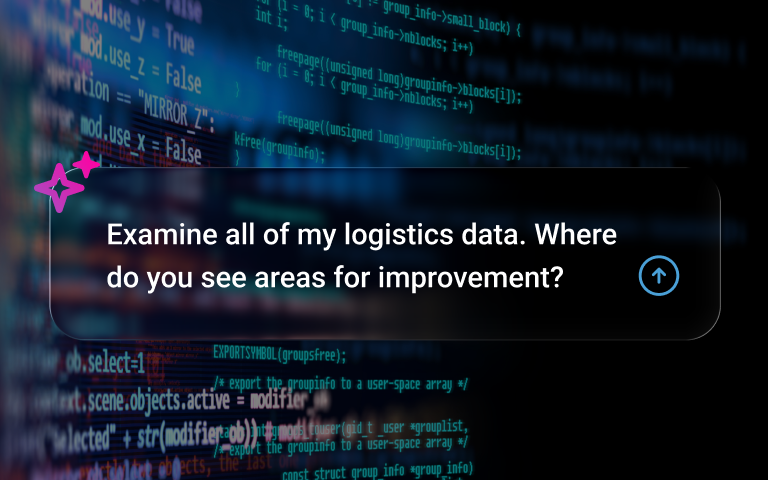
Instead of asking, "What was my carrier on-time performance in the Northeast last month?" they simply told the AI: "Examine all of my logistics data. Where do you see areas for improvement?"
AI Surfaces the Invisible, 60-Second Insight
Embedded AI identifies micro-patterns that standard key performance indicator dashboards miss entirely.
One customer demonstrated this shift perfectly. Instead of starting with a complex question, they had their AI scan their shipment history across NetSuite (their ERP) and Shipwell.
Within seconds, the AI uncovered two carriers with high cancellation rates specifically within the first 60 seconds of tender acceptance. Standard reporting environments would have buried these anomalies..
In a traditional reporting environment, these would have just been "cancelled loads" lost in a sea of data. By letting the AI "find the problem," the leadership team uncovered a specific workflow and training gap. AI didn't just answer a question; it generated an explicit insight.
Logistics Intelligence for Everyone
Natural language interfaces ensure that complex data analysis is no longer siloed inside the technology department.
There is a common misconception that supply chain intelligence requires a degree in data science or a deep understanding of AI. That’s an outdated mindset. The Shipwell MCP Server turns natural language into a powerful diagnostic tool, allowing executives and operations managers to audit thousands of loads as easily as sending a chat message.
By bridging the gap between your ERP and your freight data, the AI acts as a 24/7 auditor. It excels at finding patterns in the mess–identifying correlations between carrier types, lead times, and exception rates that are invisible to the naked eye.
Moving from Defensive to Offensive Logistics
Moving to an AI-driven model allows logistics operations to fix process sparks before they impact profitability.
Logistics leaders spend 90% of their time playing defense by reacting to missed pickups, late deliveries, and rising costs. To move to "offensive" logistics, you need a way to identify outliers and automate manual tasks before they become issues.
How Do You Start When You Don’t Know Where to Start?
You don't need to build an end-to-end automation roadmap on day one to see real operational return on investment.
Start by letting the machine handle the heavy lifting of discovery. AI that turns supply chains into systems of action can begin in a completely safe space. Here are three simple steps to transition your team:
- Connect the Shipwell MCP server to your sandbox environment to examine data without risk to live freight.
- Use broad, natural language directives like asking for the three biggest outliers in carrier performance.
- "Analyze my shipments from the last 30 days. What are the three biggest outliers in carrier performance?"
- "Is there a specific lane where we are seeing a spike in fallback rates?"
- "Look at our quoting history, are we losing sales because of speed or price?"
- Use the AI to pull specific shipment identification numbers and carrier logs once an anomaly is flagged.
Steps to Take Action
- Stop attempting to write the perfect prompt and use broad natural language directives instead
- Shift from defensive fire-fighting to offensive logistics by targeting micro-patterns
- Connect the MCP server to a sandbox environment to test discovery tools safely
- Democratize logistics data across operations and technology teams to eliminate information silos
Give your team a map of exactly where the operational friction is. Let the AI find the problems so you can focus on the solutions.
Frequently Asked Questions
How does AI surface invisible supply chain friction?
Embedded AI identifies micro-patterns that standard key performance indicator dashboards miss entirely. Traditional reports won't catch costly workflow anomalies buried under generic metrics like cancelled loads.
How do defensive and offensive logistics differ?
Shifting to an AI-driven model allows operations to resolve process sparks before they harm profitability. To play offense, you need automated tools to surface outliers before they escalate.
Do I need to clean all my data before using the MCP server?
Not necessarily. While clean data is always better, large language models are remarkably good at identifying patterns within messy or unstructured data. The AI can actually help you identify where your data is incomplete or inconsistent, which provides an immediate operational insight in itself.
How does the AI access my ERP data?
The Shipwell MCP server acts as a secure bridge. By connecting your ERP data with Shipwell’s shipment and carrier data, the AI can see the full lifecycle of a load–from the initial order in NetSuite, Infor or your preferred ERP to the final POD in Shipwell–allowing it to find cross-platform correlations.
Is my data safe when I ask the AI to "analyze" it?
Shipwell prioritizes security by using a read-only integration for all pilot phases. We use a scoped integration user, meaning the AI only has access to the specific data sets you authorize, and it cannot make unauthorized changes to your system of record.
What is the Model Context Protocol (MCP)?
The Model Context Protocol is an open standard that allows AI applications to connect with data sources and tools. It replaces the need for custom-coded integrations with a standardized way for AI assistants to "see" and "use" the data within a system like a TMS.
Next Question: How does the MCP server handle cybersecurity and data privacy?
Can my team use this even if they aren't "tech-forward"?
Absolutely. If your operations team can send a Slack message or an email, they can easily use the Shipwell MCP server. The primary interface relies entirely on natural language, meaning no coding, complex queries, or technical expertise are required to generate insights.