.svg)


How Shipwell Turns DAT Benchmarks into Faster, Smarter Coverage



Market signals belong where decisions are made. In our joint session with DAT Freight & Analytics, we showed how Shipwell brings live benchmarks into the shipment view, lets teams post to DAT in one click, and guides awards with carrier scorecards—so you cover faster without compromising performance.
Watch the full session
What is the Shipwell + DAT integration and why does it matter?
Shipwell and DAT built a partnership that integrates DAT’s industry-leading RateView Analytics directly into Shipwell’s Transportation Management System (TMS). Planners can see lane-level spot and contract rates next to the shipment, compare to their history, post to DAT without rekeying, and monitor carrier performance with scorecards.
Benchmark, act, and measure in one place–with faster, better outcomes for your team and customers.
How do you benchmark rates directly in the shipment workflow?
Benchmarking happens in context, on the shipment, so your team can see the signal, compare it to your history, and act in one motion. In day-to-day operations, Shipwell puts the signal and the action in one place.
- On the shipment screen, open “Pricing Intelligence.” Planners will immediately see Shipwell surfacing DAT’s 3‑day rolling average with 25th-75th percentile ranges and sample sizes, plus 12 months of history and a 35‑day forecast for forward planning.
- Still on the “Pricing Intelligence” pane, compare your buys against the market. You can do this at the lane level or in aggregate, then use that signal to inform tenders, spot buys, and RFP targets in Shipwell.
- If the market is running below your guide, you pivot: adjust your tender sequence, set a Book Now price anchored to the benchmark, or capture a target for the upcoming RFP without leaving Shipwell
The result is a cleaner chain of custody from insight to award without leaving the platform, so decisions reflect current conditions instead of last quarter’s playbook.
How do we source capacity with control?
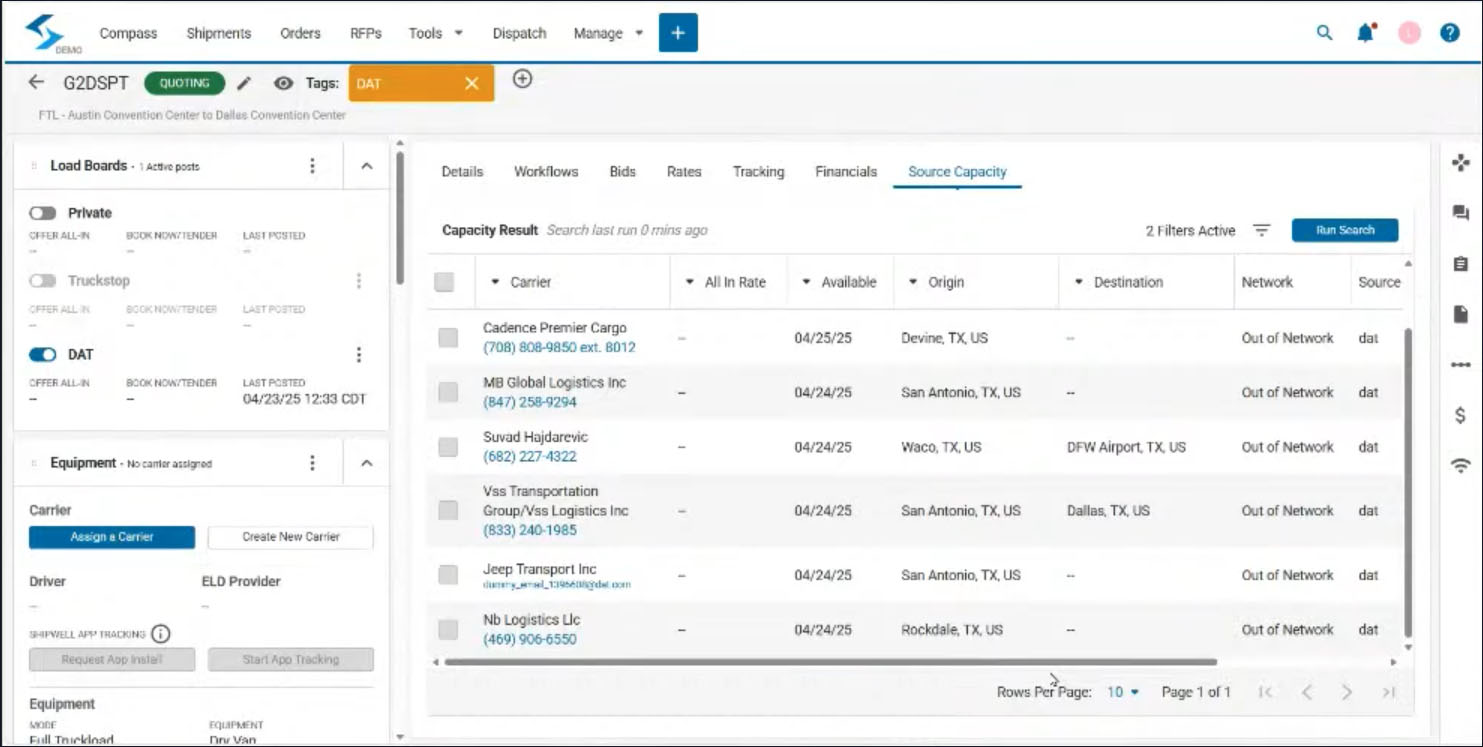
From the “Source Capacity” panel on the shipment, set filters for in‑network/out‑of‑network, radius, equipment, and availability, then run one search across your carriers and DAT’s marketplace. From there, run a search to pull back the carriers that have capacity and meet your requirements (whether the carrier is known or unknown to you.) This way, you expand options without losing governance or context.
How do we balance price and performance in one view?
Cheapest rarely equals lowest total cost. Shipwell’s scorecards keep service front and center—on‑time delivery, tender acceptance, and tracking—so planners can weigh price against proven reliability before awarding freight. DAT’s Carrier Management Suite adds fraud‑prevention signals; together, you de‑risk faster without slowing coverage.
What market signals should shape the next planning cycle?
During the session, we highlighted three realities:
- Volatility persists: spot rates for dry van and temp‑control fell in March/early April while contract rates remained comparatively stable.
- Tariff uncertainty: shifting announcements spurred early imports and a short‑term container surge that is unlikely to persist.
- Macro pressure: core inflation ~2.4%, headline closer to ~2.8%; University of Michigan sentiment at 50.8, the second‑lowest since the 1950s, both pointing to potential demand softness. Flatbed spiked briefly; intermodal is tightening earlier than usual.
There is no question that flexible, data‑led playbooks outpace static routing guides under these conditions.
What did attendee polls say about priorities?
The top three priorities coming out of the session were: cost pressure, rate volatility, and recent capacity shortages.
For postings, richer equipment/accessorial detail and automatic refresh rose to the top. Many teams still call carriers directly during peaks—exactly where private networks, faster benchmarking, and Book Now compress cycle time in Shipwell.
How do you turn the integration on?
Enable the DAT tile in Shipwell’s integration marketplace. Each Shipwell user authenticates with their own DAT credentials. RateView Pro supports core lookups and best‑fit escalations; RateView Premium unlocks additional escalation types. Once enabled, you can benchmark and post directly from the TMS.
Who joined me on the session, and why Shipwell?
I was joined by Larry Lewis (Senior Consultant, Shipwell) and Cole Hytjan (Product Manager, DAT). We showcased how Shipwell’s modern, configurable TMS unifies planning, execution, visibility, analytics, and RFP automation—so teams get to value faster and operate in a single pane of glass, with real‑time market signals embedded at decision points. Watch the full session.