.svg)


Takeaways From the 2026 Gartner Supply Chain Symposium/Xpo

Key Takeaways

- Commit to a true AI-native infrastructure instead of forcing advanced automation into rigid, legacy workflows that stall your progress at the pilot phase.
- Price structural flexibility directly into your network strategy so your operations can easily adapt to sudden tariff shifts and upstream supplier blind spots.
- Bridge the executive credibility gap by transforming from a reactive backend troubleshooter into a forward-thinking strategist who speaks the language of corporate growth and profitability.
The speed in which global commerce is moving opens up opportunities for agile shippers ready to capitalize on the change.
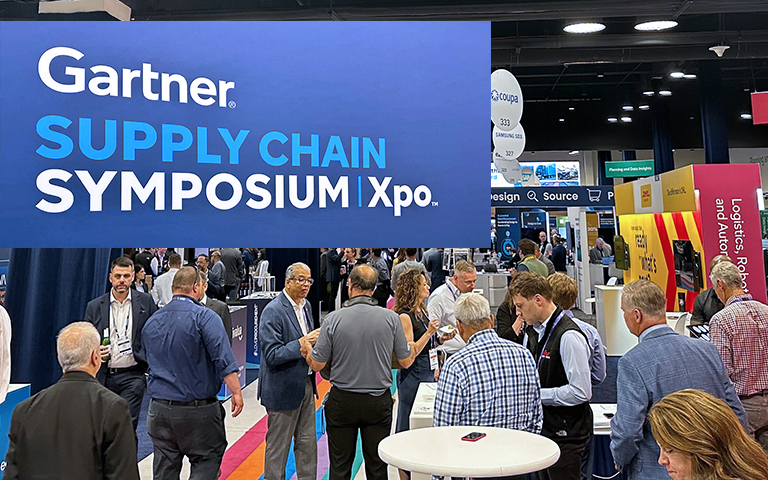
At the recent Gartner Supply Chain Symposium/Xpo, the clearest message for supply chain leaders was that the old playbooks and manual data processing are not enough to compete. The industry is at a crossroads where AI, shifting global trade policies, and a need for extreme adaptability are rewriting the rules of leadership.
Here’s my rundown of the critical insights from the front lines of supply chain innovation.
How Is AI Restructuring Modern Supply Chain Operating Models?
While most logistics investments now fund artificial intelligence, 77% of leadership teams struggle to scale these tools past the pilot phase. Shifting from simple plug-in tools to a true AI-native infrastructure eliminates administrative waste and unlocks massive bottom-line value.
AI Is Rebooting the Way Companies Do Business
The most significant finding from the symposium is that most companies are fundamentally unready for an AI-driven future. While 67% of supply chain digital investment is flowing toward AI, a staggering number of leaders admit their current operating models cannot compete. The bottleneck isn't the technology itself, but scalability; currently, only 17% of AI pilots make it to full-scale deployment.
Gartner’s prescription is a bimodal roadmap:
- Mode 1 (Embed): Integrate AI into existing processes for immediate efficiency gains.
- Mode 2 (Redesign): Build an AI-native operating model from the ground up.
Some leaders said that a complete Mode 2 overhaul brings severe operational friction. Others say it introduces an unacceptable amount of deployment risk.
The truth is that legacy systems simply cannot scale to meet modern data demands.
Why Is Manual Entry for Trade Compliance Going Away?
Increasing tariff challenges and greater regulatory audits have pushed manual entry validation to its breaking point. Utilizing AI agents for automated classification minimizes compliance errors and slashes human review workloads by up to 80%.
The End of Legacy Trade Compliance
Tariffs are the new normal. With tariff exposure now spanning multiple countries and product lines simultaneously, workloads cannot sustain manual entry-by-entry validation. As CBP audit intensity increases, teams relying on spot-checks are finding that errors surface only after filing, when they are most expensive to fix.
AI agents are filling this critical gap. In a standout success story shared by one consulting firm, AI agents were able to cut trade review efforts by 80%, saving their client over $3M. 90% of that value was tied directly to USMCA classification work, proving that autonomous agents can handle the complexity that humans simply cannot scale.
How Should Shippers Calculate Network ROI Amid Market Volatility?
Traditional supply chain network designs focusing exclusively on static setup and freight costs fail during geopolitical and operational disruptions. Modern network ROI requires pricing in three distinct vectors of adaptability: operational, network, and capital adaptability.
New Math for Network Strategy
A new framework for network strategy adds three explicit pillars of adaptability:
- Operational Adaptability: The cost of absorbing ongoing friction.
- Network Adaptability: The structural cost of diversifying the network.
- Capital Adaptability: The resources required to pivot infrastructure.
The goal isn't to ignore cost, but to "price in" the ability to flex. Adaptability is the new efficiency.

How Can Chief Supply Chain Officers Bridge the C-Suite Credibility Gap?
There is a vast disconnect between how Chief Supply Chain Officers (CSCOs) see themselves and how they are perceived by the rest of the C-suite. While 75% of CSCOs rate their own effectiveness highly, only about 50% of their peers agree. Most concerningly, only 12% of C-suite peers believe their CSCO is ready to step into the CEO role.
Addressing The CSCO Credibility Gap
To bridge this gap, CSCOs must move beyond functional execution and become "enterprise-ready" leaders. This requires a shift toward growth-enabling, board-facing, and P&L-fluent leadership—turning credibility into the new currency of supply chain influence.
Leaders must transform into enterprise-ready strategists by focusing on:
- Growth-Enabling Value: Demonstrating how transportation reliability expands geographic market share.
- Board-Facing Communication: Translating freight data into macroeconomic risk mitigation strategies.
- P&L Fluency: Aligning logistics investments directly with corporate net margin improvements.
What Are Blind Spots in Modern-Day Supply Chain Risk Management?
Visibility remains a "critical gap" in the industry. Only 33% of organizations have proactive measures to mitigate disruptions, while 44% still respond reactively to medium-to-high impact events. Despite being the partners closest to the enterprise, 63% of respondents named visibility into Tier-1 suppliers as their top gap.
Without real-time data integrations into these upstream networks, enterprise shippers remain trapped in a continuous cycle of reactive firefighting.
Is AI Replacing Logistics Jobs or Redesigning Workflows?
Contrary to the headlines, AI is not driving a mass layoff story in the supply chain; it is driving a workflow redesign challenge. Hiring and retaining labor remains a top challenge for 28% of CSCOs.
The focus has shifted to upskilling, prioritized by 46% of leaders, to build an "agile talent stack". The winning strategy treats AI as a productivity multiplier for existing staff rather than a substitute for it.
What Is Agentic Commerce?
Agentic commerce is a creative way to talk about AI agents directly referencing logistics data to make automated procurement and fulfillment decisions.
The Rise of Agentic Commerce
Gartner predicts that over 50% of large organizations will compete as collaborative digital ecosystems rather than discrete firms. This is the era of "Agentic Commerce," where AI agents (not just people) query supply chain data directly to make buying decisions.
The supply chain is becoming a public-facing API. Readiness, however, is uneven:
- 60% of retailers can share specific delivery dates.
- 19% offer item-level free shipping.
- Almost 0% share return-rate data.
The companies with clean, shareable data will be the ones that win an AI agent's recommendation.
Forging the Path Forward
The transition to an AI-native operating model is not a single leap but an intentional journey. While the symposium highlighted significant challenges, it also provided new formulas and frameworks necessary to overcome them.
Success will belong to the CSCOs who can:
- Execute a Bimodal Strategy: Simultaneously exploit AI for quick wins in today's processes (Mode 1) while redesigning an AI-native operating model for the future (Mode 2).
- Invest in Adaptability: Price in the cost of flexibility by accounting for operational, network, and capital adaptability to withstand constant turbulence.
- Bridge the Credibility Gap: Broaden their focus from functional execution to growth-enabling, P&L-fluent leadership that earns the trust of the entire C-suite.
- Redesign for Talent: Treat AI as a productivity multiplier that requires upskilling and workflow redesign rather than a simple substitute for human staff.
The supply chain is becoming a public-facing API in an era of agentic commerce. As we move toward 2030, the companies that prioritize clean data, trusted ecosystem partnerships, and proactive risk management will be the ones that win. Not just the ones with human loyalty, but the AI agent’s recommendation too.
Frequently Asked Questions
What was the biggest takeaway of the 2026 Gartner Supply Chain Symposium/Xpo?
Legacy cost-cutting playbooks are officially obsolete. Gartner made it clear that surviving modern market volatility requires a shift toward AI-native, adaptable operating models. True efficiency isn't about pinching pennies anymore; it's about structural agility.
Why are most companies unready for AI-driven logistics infrastructure?
Most companies struggle because they’re trying to force advanced artificial intelligence into rigid, human-centric workflows. While 67% of digital budgets fund AI projects, only 17% of pilots successfully scale. The bottleneck isn't the technology—it’s the lack of a flexible operating framework.
What is the difference between Mode 1 and Mode 2 AI implementation?
Think of Mode 1 as a quick win—embedding AI into your existing processes to boost localized efficiency. Mode 2 is where the real magic happens: completely rebuilding your operating model from the ground up to be AI-native.
How do autonomous AI agents improve international trade compliance?
Manual spot-checks are a massive liability when tariffs shift daily. Autonomous AI agents solve this by validating classifications before you file, catching expensive errors early.
What is operational adaptability in freight network strategy?
Operational adaptability is your network’s financial capacity to absorb daily friction, like port congestion or missed pickups, without breaking down. Instead of just designing for the lowest immediate cost, it prices in flexibility. This ensures your operations remain resilient when real-world disruptions occur.
Why do corporate peers doubt the executive readiness of Chief Supply Chain Officers?
75% of CSCOs rate themselves highly, but only 12% of C-suite peers think they're ready for the CEO role. Peers see them as functional managers rather than commercial leaders. To bridge this, you need to speak the language of growth, board strategy, and P&L fluency.
Where is the biggest visibility gap located within modern supply chains?
Surprisingly, it's right at your doorstep. While 44% of companies respond reactively to disruptions, a staggering 63% name Tier-1 suppliers as their top blind spot. Even though these direct manufacturing partners are closest to your business, legacy tracking keeps you in the dark.
How does agentic commerce alter procurement pipelines?
AI agents, not just people, buy your products. In agentic commerce, autonomous software queries supply chain data directly via public APIs to make procurement decisions. If your data is messy or isolated, these digital buyers will filter you out immediately.
Does implementing supply chain AI trigger immediate corporate layoffs?
Not necessarily. Think of AI as a productivity multiplier, not a replacement for your team. Finding great logistics talent is still a major hurdle for 28% of CSCOs. That’s why 46% are focusing on upskilling to build an agile talent stack, offloading tedious tasks so people can focus on strategy.
How frequently should enterprise shippers update their logistics network strategy?
With shifting tariffs, port capacity swings, and volatile lanes, you should stress-test your network strategy quarterly. Moving from static annual planning to dynamic, continuous adjustments keeps your operations ahead of macro market shocks.